When a rental appliance needs to be replaced, the easiest number to compare is the price on the appliance. That number matters, but it is only the starting point. For a Richmond rental owner, the better comparison is what the appliance will cost by the time it is delivered, connected, tested, and ready for the resident to use.
PMI James River's rental maintenance process treats appliance replacement as more than an online purchase. Delivery, installation, required parts, haul-away, warranty terms, return limits, and property-specific corrections can all change the economics. Those same controls sit inside our rental maintenance operations framework: known costs should be identified before approval, and uncertain costs should be separated instead of disappearing inside an incomplete estimate.
New retail and scratch-and-dent can both be good purchases. The useful question is not which label sounds cheaper. It is which option gives the property a dependable, ready-to-use appliance at the better total cost with an acceptable path if something goes wrong.
Key Takeaways
- Compare the total ready-to-use cost, not just the appliance price.
- Scratch-and-dent, open-box, clearance, refurbished, and used are different categories. Verify what the exact unit is before comparing prices.
- Delivery, installation, required parts, haul-away, and property corrections can erase an apparent discount.
- Warranty and return terms matter because a cheap purchase becomes expensive if a problem requires another delivery, another installer, or a difficult claim.
- PMI James River generally favors new, basic, dependable washers and dryers over used or feature-heavy machines when the owner is supplying laundry equipment.
First, Make Sure the Comparison Is Actually New vs. Scratch-and-Dent
"Discounted appliance" covers several different things. They should not be treated as one category.
Best Buy's current Outlet definitions are a useful example. It describes clearance items as new and factory sealed, open-box items as customer returns that may show cosmetic wear, refurbished products as restored to like-new condition, and pre-owned products as previously used.
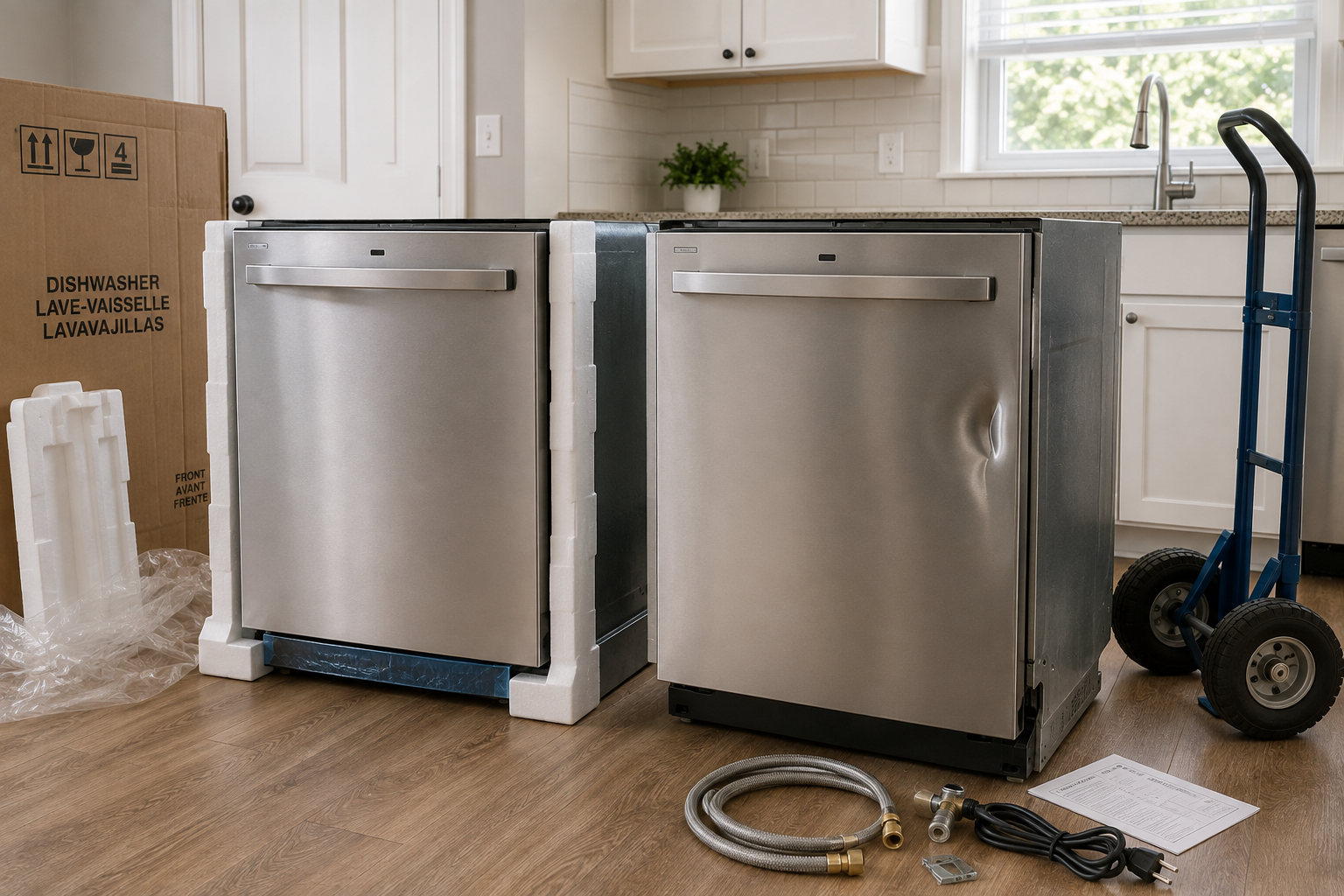
Scratch-and-dent can overlap with open-box, but the label alone does not establish the appliance's history. A rental owner should confirm whether the exact unit is new, returned, displayed, refurbished, or previously used; what damage exists; whether it has been tested; what accessories are included; and what warranty follows that particular unit.
This distinction matters most when owners compare scratch-and-dent with used equipment. A harmless dent on the side of an essentially new dishwasher is a different risk from a washer with an unknown service history. PMI James River's position on owner-supplied laundry is deliberately conservative: when the property will include a washer and dryer, we generally prefer new, basic, dependable equipment rather than used or feature-heavy machines. The separate decision about whether a Richmond rental should include a washer and dryer belongs to the leasing and amenity side of the decision.
The Number That Matters Is the Ready-to-Use Cost
A useful comparison is simple:
Ready-to-use cost = appliance price + delivery + required parts + installation + haul-away + known property corrections.
That calculation often changes the winner.
As one current Richmond example, a local scratch-and-dent retailer publishes separate charges for delivery, installation, and haul-away. As of August 2026, its published dishwasher service estimates are $25 for delivery, $109 for installation, and $25 for optional haul-away. That is $159 before any property-specific correction. An apparent $150 purchase-price advantage would already be gone if the competing option included those services.
Large retailers also separate the appliance from the work required to put it into service. Lowe's currently says its dishwasher installation requires a new connector hose, does not allow the existing connector and cords to be reused under its installation program, and treats installation and haul-away as separately purchased services.
The property can add another layer. PMI James River manages rentals across Richmond City, Henrico County, and Chesterfield County with different ages, layouts, access conditions, and utility configurations. The same appliance can be a simple swap in one property and a more complicated installation in another. A shutoff valve may not work. A dishwasher opening may need adjustment. A refrigerator may need a usable water connection. A dryer may need the correct electrical connection or vent configuration. The appliance can be inside the house and still not be ready to use.
For a vacant rental, that matters because unresolved appliance work can hold up the rent-ready condition. For an occupied property, it can mean another resident appointment and more time without a working appliance.
When Scratch-and-Dent Is Usually the Better Buy
Scratch-and-dent is attractive when the discount survives the full calculation and the defect does not affect the property's operation or presentation.
A side-panel dent hidden beside a cabinet may be financially irrelevant. A scratch on the rear of a washer may never be visible after installation. Paying full retail to eliminate damage nobody will see does not automatically improve the rental.
The strongest scratch-and-dent purchase usually has most of these characteristics:
- the exact unit can be inspected before purchase;
- the damage is cosmetic and does not affect doors, seals, controls, connections, or fit;
- the appliance has been tested;
- dimensions, utilities, and access have already been confirmed;
- the warranty and return terms are clear;
- the appliance is available quickly enough to solve the property's timing problem; and
- the final ready-to-use cost is still meaningfully lower than a comparable new retail option.
Visible condition still matters. PMI James River's rent-ready standard does not require every appliance to be new or luxurious, but the home should look finished and intentional. A cosmetic flaw that disappears beside cabinetry is different from a badly dented front panel in an otherwise clean kitchen.
Availability can also create value. A scratch-and-dent unit that is physically in Richmond and can be installed tomorrow may be the better purchase than a slightly cheaper online unit that is backordered for a week. Time is part of the cost when the property is vacant or the resident is waiting on a supplied appliance.
When New Retail Is Worth Paying More
New retail often wins when the price difference is small, the delivery and installation path is simpler, or the owner is buying greater certainty about the product's history and support.
It becomes especially attractive when:
- a current sale narrows the price gap;
- delivery, installation, or required parts are bundled more favorably;
- the retailer has a cleaner replacement or service process;
- the owner wants to standardize common models or configurations across several properties;
- the appliance is difficult to access or install, making a failed first attempt especially disruptive; or
- a modest initial saving is not worth a materially higher risk of another repair or replacement.
Laundry is where PMI James River applies this most clearly. We generally favor basic machines that do the core job well. Smart connectivity and a long list of specialty features rarely improve the rental enough to justify buying additional complexity solely for the feature set.
This is also where the purchase decision connects to broader rental repair economics. The lowest initial invoice is not always the lowest operating cost if it creates another service call, another resident disruption, or another replacement sooner than expected.
Warranty and Return Terms Can Change the Answer
A warranty only has value if the owner knows what it covers and how the claim actually works.
Before approving the purchase, confirm:
- who provides the warranty;
- how long the coverage lasts;
- whether parts and labor are both covered;
- whether service happens at the rental or the appliance must be transported;
- who pays for pickup, redelivery, or another installation;
- when the return window begins; and
- whether cosmetic damage, sizing problems, delivery charges, installation, or restocking fees are excluded.
Current retailer policies show why this cannot be assumed. One Richmond scratch-and-dent seller currently states that it accepts returns within 48 hours and applies additional restocking and pickup charges after that window for a working appliance; delivery and service fees are nonrefundable. Its published warranty terms also differ for some brands.
Lowe's uses a different structure. Its current major-appliance return policy generally requires a return to be initiated within 48 hours of delivery or pickup, subject to listed exceptions. Lowe's Outlet purchases are narrower: the published policy says major-appliance returns are accepted for qualifying mechanical or electrical defects that make the appliance nonfunctional, while cosmetic damage and insufficient size are not accepted return reasons.
That makes immediate inspection and testing important. The owner or manager should confirm visible condition, correct model, fit, connections, basic operation, and any obvious leaks or installation issues while the return or damage-reporting path is still open.
PMI James River also treats the paperwork as part of the purchase. Receipt, model and serial information, warranty documents, installation records, and any documented cosmetic damage should stay with the property file. That reduces guesswork when the appliance needs service later and supports the broader maintenance coordination process.
Frequently Asked Questions
Is Scratch-and-Dent the Same as Used?
No. A scratch-and-dent appliance may be new, open-box, returned, or otherwise cosmetically blemished depending on the seller. A used appliance has previously been in service. The exact unit's history matters more than the sales label.
How Much Cheaper Should Scratch-and-Dent Be Before It Is Worth Buying?
There is no useful universal percentage. Compare the final ready-to-use cost after delivery, installation, parts, haul-away, and known property work. Then consider warranty, return terms, availability, and the appliance's condition. A large sticker discount can become a small real saving after those items are added.
Should a Landlord Buy Used Appliances for a Rental?
It depends on the appliance, price, service history, and risk. PMI James River's clearest preference is for owner-supplied washers and dryers, where we generally favor new, basic, dependable machines over used units. A scratch-and-dent machine can still fit that approach when it is essentially new or open-box and the cosmetic damage does not affect operation.
Are Extended Warranties Worth Buying?
Not automatically. Compare the plan cost with the appliance price, expected replacement cost, coverage exclusions, service process, and how much administrative friction the plan actually removes. The manufacturer's included warranty and the retailer's return path should be understood first.
Compare Two Numbers Before Approving the Purchase
The first number is the cost to get the appliance working today. The second is the likely cost and friction if something goes wrong afterward.
That keeps the decision practical. A Richmond rental owner does not need to pay full retail just to avoid a harmless cosmetic dent. The owner also should not save a small amount on the appliance if delivery, installation, weak support, or an uncertain service history makes the overall purchase more expensive.
For owners who do not want to coordinate the measurements, ordering, delivery window, resident access, installer, exception handling, paperwork, and warranty follow-up themselves, PMI James River's maintenance coordination system is designed to handle that work while preserving owner control over the decisions that actually matter.
Published: August 21, 2026