For Richmond Metro rental owners, the best repair-or-replace decision usually comes down to three things: how certain the diagnosis is, how much dependable life appears to remain in the appliance, and how the completed repair compares with the realistic cost and timing of replacement. PMI James River's rental maintenance services are built to get those facts in front of the owner before a routine work order turns into repeated spending.
Our rental maintenance operations framework treats repair-versus-replace choices as owner decisions because no single percentage answers them well. Appliance age matters. So do condition, repair history, warranty coverage, parts availability, resident disruption, and what replacement will actually cost once it is installed.
Appliance failures are normal operating events in rental ownership. A good decision process directs the next maintenance dollar toward the option most likely to produce dependable service.
Key Takeaways
- The 50% rule is a useful screening shortcut, not a complete rental-property decision.
- A clear diagnosis and a healthy remaining appliance strengthen the case for repair.
- Repeat symptoms, multiple condition problems, uncertain diagnosis, or difficult parts strengthen the case for replacement.
- Compare repair cost with the completed replacement cost, not only the appliance's retail price.
- Keep the model, serial number, warranty information, repair history, and callback record. Those facts make the next decision easier.
The 50% Rule Is A Screen, Not The Decision
A current Angi repair-or-replace guide uses a familiar rule of thumb: if the repair costs less than half the price of replacement, repair often deserves serious consideration. Angi also cautions that appliance age and condition can change that answer.
That is a reasonable first screen. It is incomplete for a rental.
A $200 repair can be a strong decision when the technician has identified a specific failed part, the rest of the appliance is in good condition, the part is available, and there is no pattern of recent trouble. The same $200 is harder to justify when the symptom is intermittent, the machine has other visible problems, or recent repairs have not produced reliable service.
Replacement cost needs the same discipline. A retailer's price does not necessarily include delivery, installation, required connection parts, haul-away, fit corrections, or property-specific work discovered during installation. The owner should compare the repair with the realistic cost of putting a working replacement into service.
Six Facts That Can Change The Answer
1. Diagnosis Confidence
The strongest repair decisions start with a specific diagnosis. "The drain pump failed and tested bad" gives the owner more useful information than "the dishwasher sometimes loses power." Intermittent symptoms deserve more caution because the first visit may not reproduce the condition.
If another professional opinion could materially change the diagnosis, scope, or replacement decision, a second repair quote can be worthwhile. It should solve a real uncertainty rather than become an automatic extra service call.
2. The Rest Of The Appliance
Age alone is not enough. An older appliance with one clear failure and otherwise solid condition can still justify repair. A newer appliance with rust, damaged racks, deteriorated seals, noisy operation, control problems, or several unrelated weaknesses may be a poorer candidate.
A practical question is: if the proposed repair works exactly as intended, what condition will be left behind?
3. Repair And Callback History
The next invoice should be read alongside the previous ones. Diagnostic charges, parts, labor, callbacks, and repeated resident appointments all belong in the history.
Past spending is sunk, so it should not force the next decision. Repeated spending without dependable service does provide useful evidence that the next repair deserves more scrutiny. That same pattern is part of the broader economics of reactive repairs.
4. Warranty And Repairability
Before authorizing paid work, check whether the appliance is still covered. The Federal Trade Commission's warranty guidance recommends checking what the warranty covers, what the company will do if the product fails, and how the repair claim must be handled. Keeping the purchase receipt and warranty record can make that process much easier.
Repairability also matters. The FTC has separately highlighted parts availability and access to repair information as practical issues that can make products harder to fix. A repair that looks attractive on price can lose its advantage if a critical part has an uncertain lead time.
5. Time Without The Appliance
An in-stock part and one scheduled return visit create a different decision from a backordered board with an uncertain arrival date. For an occupied rental, time also means resident communication, access coordination, another appointment, and the possibility of another callback if the repair does not hold.
Those costs do not always appear on the contractor invoice, but they are part of operating the property.
6. Completed Replacement Cost
If replacement is being considered, the owner needs a realistic completed number. Delivery, installation, connections, haul-away, fit, and unexpected installation conditions can all change the final cost.
Once the owner decides replacement is warranted, the next questions are which appliance to buy and where to buy it. Those are separate decisions. This article stops at whether continuing to repair the existing appliance still makes sense.
Two Richmond-Area Dishwasher Decisions
A $150 Repair That Lost To Replacement
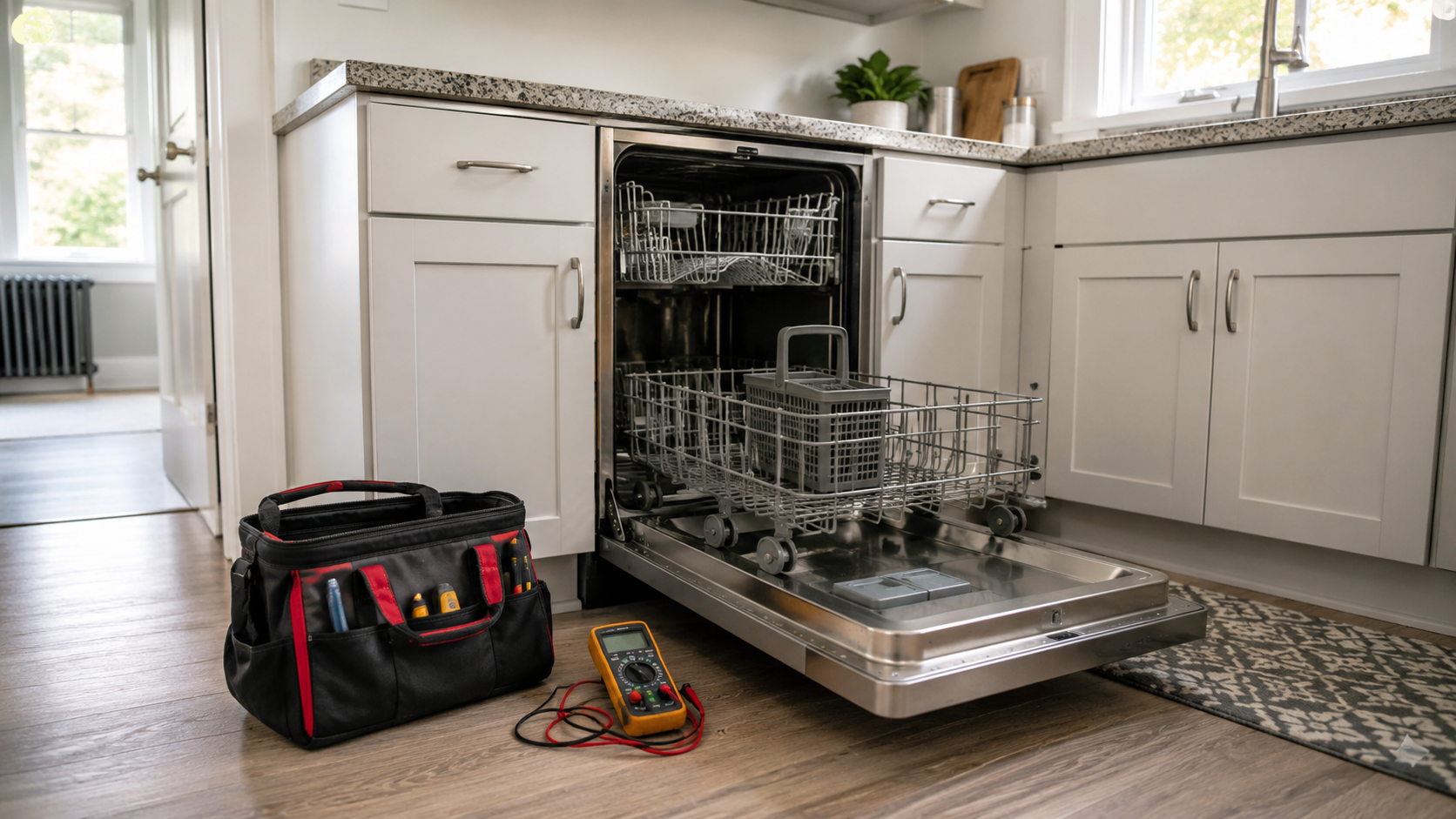
In one recent PMI James River work order, a dishwasher needed a lower spray-arm repair estimated at about $150. The information initially available suggested the dishwasher was a 2023 unit. On that fact pattern, repair looked attractive.
The physical condition raised another question. The upper rack had rust damage and was not moving correctly. We then verified the serial information and found that the dishwasher dated to April 2013, not 2023.
That changed the decision. The owner was no longer considering a modest repair to a nearly new dishwasher. The choice was whether to put another repair into an older appliance that already had other condition problems. The owner chose replacement.
The completed work order ultimately reached $638.25 after installation fit and connection conditions required additional contractor work. The replacement still made sense based on the condition of the old dishwasher. The case also showed why the owner needed both the actual condition of the old machine and the completed cost of installing the new one before judging the decision.
A $342.94 Repair That Worked, Then The Symptom Returned
At a Chesterfield County rental, another dishwasher had an intermittent power problem. The technician identified a control-related issue, ordered the part, and completed the repair. After a $99 diagnostic credit was applied, the total came to $342.94.
The dishwasher initially worked. Within days, the resident reported that the same intermittent power problem had returned. The machine completed several loads, required repeated resets, and then stopped powering on again.
That sequence does not prove the first repair was unreasonable. The technician had a diagnosis and a defined repair path, and intermittent failures can be difficult to reproduce. It does change the next decision. The owner now has a recent repair cost, a repeated symptom, another access cycle, and less confidence that another repair will produce dependable service.
This is why PMI James River's maintenance coordination process preserves the reported symptom, diagnosis, owner approval, invoice, callback history, and closeout notes. The next decision should start with the appliance's actual record rather than from zero.
A Practical Repair-Or-Replace Test
Repair has the stronger case when most of these are true:
- The diagnosis is specific and the proposed repair directly addresses it.
- The rest of the appliance is in good condition.
- There is little or no troublesome recent repair history.
- The needed part is available and service can be restored promptly.
- Warranty coverage helps with the repair, or the out-of-pocket cost remains meaningfully below the completed replacement cost.
- If the repair succeeds, the owner is likely to have a dependable appliance rather than one obvious failure followed by another.
Replacement has the stronger case when several of these are true:
- The appliance has multiple unrelated signs of decline.
- The same or similar symptom has already produced callbacks.
- The diagnosis remains uncertain enough that another repair may simply buy another diagnostic cycle.
- Parts are delayed, difficult to source, or expensive relative to the value of the appliance.
- Recent repair spending is accumulating without reliable service.
- Replacement can restore service sooner or with materially more confidence at a reasonable completed cost.
The decision becomes easier when the property file contains the appliance model and serial number, purchase date when known, warranty information, prior invoices, technician findings, and callback history. Those records turn the next repair from a guess into a comparison.
Quick Answers For Rental Owners
Should An Owner Automatically Replace An Old Appliance?
No. Age is context. A clear, modest repair on an older appliance that has otherwise been dependable can still make sense. Age becomes more persuasive when it appears alongside repeat failures, declining condition, or difficult parts.
Should A Rental Owner Repair Anything Under 50% Of Replacement Cost?
No. The 50% rule is a screening shortcut. Diagnosis confidence, condition, warranty, repair history, part timing, and the completed replacement cost can all change the answer.
Should Every Appliance Replacement Get A Second Quote?
No. Another opinion is useful when it can resolve a genuine uncertainty about diagnosis, scope, price, or whether replacement is warranted. If the failure and economics are already clear, another service call may add cost and delay without changing the decision.
Rental appliances will eventually need repairs and replacement. A consistent process helps owners spend on the option most likely to restore dependable service without turning normal maintenance into repeated guesswork. For Richmond rental owners who want diagnosis, owner approvals, resident access, vendor coordination, callbacks, and documentation handled through one system, PMI James River can manage the process through our rental maintenance services.
Published: August 21, 2026