
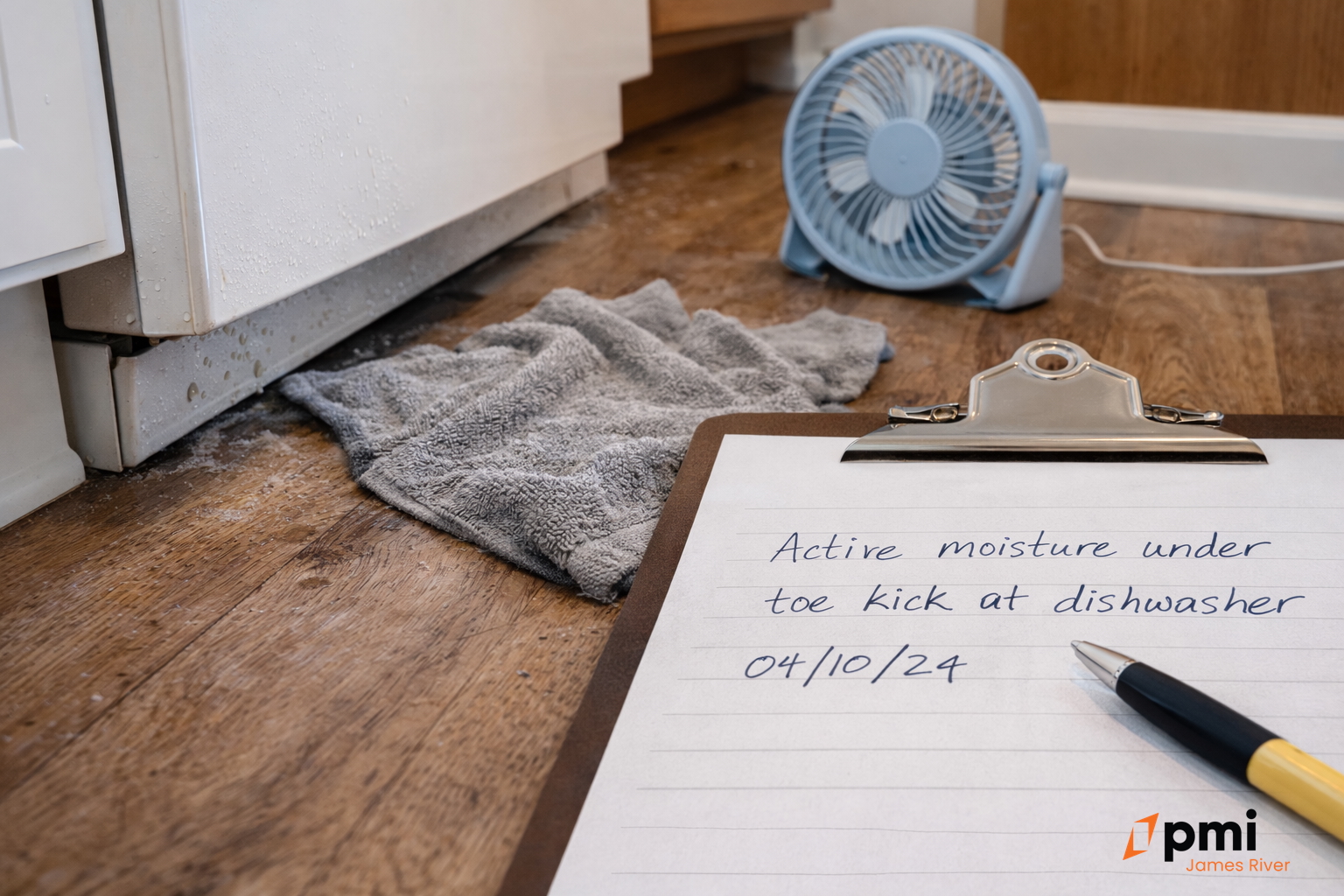
Moisture disputes are difficult because the final floor shows the end of the story, not necessarily what caused it. Swelling, staining, odor, edge separation, or a damaged subfloor can result from very different sequences. The useful question for a rental owner is what the record can prove about the starting condition, first symptom, notice, access, repair response, and any worsening that followed.
Across Richmond City, Henrico, Chesterfield, and Hanover, the same Virginia legal duties apply even though flooring materials, appliance layouts, subfloors, humidity, and building age vary from property to property. That is why a move-out photograph should start the investigation rather than finish it.
A strong moisture file combines the condition history created through a disciplined maintenance documentation process with the broader classification rules in our guide to wear and tear versus damage in Virginia rentals. The purpose is to reconstruct what happened before deciding who should bear a cost.
Key Takeaways
- Moisture responsibility should be evaluated from the timeline, not from the severity of the final photograph.
- The most useful dates are the starting-condition record, first observed symptom, notice, first service attempt, on-site assessment, repair completion, and recheck.
- Virginia law places moisture-related duties on both residents and landlords, so delayed reporting and delayed response are different issues that should be documented separately.
- Flooring symptoms can suggest a mechanism, but swelling, cupping, odor, or edge damage does not by itself prove who caused the condition.
- After responsibility is established, the repair or deposit charge should still match the loss the file can actually prove.
In This Guide
- Build the timeline first
- Use mechanism evidence, not appearance alone
- How flooring type changes the evidence
- Separate reporting delay from repair delay
- Match scope to what the file proves
- Build an auditable moisture file
Build the Timeline First
The most reliable way to evaluate a disputed moisture loss is to reconstruct the event before assigning responsibility. A useful file normally contains several separate dates.
- Starting condition. What did the floor, wall, cabinet base, appliance area, or other affected surface look like at the beginning of the tenancy?
- First observed symptom. When was staining, swelling, odor, leakage, condensation, or another condition first noticed?
- Notice. When was the issue reported, through what channel, and what exactly did the report say?
- First service attempt. When was entry scheduled or first attempted? Record reschedules, missed appointments, and access problems separately.
- On-site assessment. When did a vendor or property manager first observe the affected area, and what conditions were documented?
- Repair completion. When was the source actually repaired or corrected?
- Recheck. Was the area later confirmed dry, stable, or free from recurring symptoms?
The baseline matters because Virginia Code § 55.1-1214 requires a written move-in report identifying existing damage within five days after occupancy, subject to the statute's objection process. A strong starting record makes later comparisons much easier. Rental owners can review the broader documentation process in our Virginia move-in and move-out guide, and the statutory rule is available directly from the Code of Virginia.
At PMI James River, the condition notes and photographs are treated as one move-in record whether the resident completes the process electronically or on paper. That makes the later maintenance and move-out record easier to compare against a single documented baseline.
Use Mechanism Evidence, Not Appearance Alone
Two damaged floors can look similar at move-out and still have very different histories. Vendor observations are useful because they can narrow the possible mechanism and duration without pretending that appearance alone proves fault.
Useful observations include:
- Active versus historic moisture. Was water or elevated moisture still present, or did the area show only evidence of an earlier event?
- Localized versus spreading damage. Was the condition confined to the immediate source area, or did it extend into adjacent flooring, cabinetry, drywall, or subfloor?
- Intermittent versus continuous symptoms. Did the problem occur only during appliance use, rainfall, HVAC operation, or another identifiable condition?
- Condition at the first visit. Photographs, moisture readings when appropriate, odor location, staining patterns, and visible deterioration are more useful when captured before demolition or drying changes the scene.
- Condition after repair. A recheck can show whether the source was actually resolved or whether the problem continued.
Timing matters because moisture can compound damage. The U.S. Environmental Protection Agency recommends acting quickly after leaks or spills and drying wet or damp materials within roughly 24 to 48 hours where possible to reduce mold growth. That is an important moisture-control guideline, but it is not a Virginia legal deadline for determining who is responsible for a rental loss. The file still has to show when the condition was known and what each party did next. The EPA's current guidance is available in its guide to mold and moisture control.
How Flooring Type Changes the Evidence
Flooring type matters because different materials react differently to moisture and environmental conditions. It should change what the owner investigates, not create an automatic conclusion about responsibility.
Hardwood and Engineered Wood
Wood reacts to the moisture in its environment. The National Wood Flooring Association explains that wood can gain moisture and swell in humid conditions, and increased moisture can cause cupping. Wood can also shrink, gap, or split as it loses moisture, with some seasonal change considered normal. That means cupping or gaps should be evaluated alongside the indoor environment, leak history, starting condition, and vendor observations rather than treated as proof of one particular cause. The NWFA's moisture-management guidance provides useful technical context.
Laminate and Floating Floors
Visible seam or edge changes deserve investigation, but the appearance alone does not establish how long moisture was present or where it came from. Product construction, installation method, expansion space, subfloor condition, and manufacturer requirements can all affect what a vendor should evaluate.
Luxury Vinyl, Vinyl, and Tile Systems
A relatively intact surface does not always answer what is happening below it. When the facts suggest water may have traveled underneath the finished surface, the vendor should document the underlayment or subfloor condition where inspection is reasonably possible. The owner should avoid converting a hidden-condition possibility into a liability conclusion before that evidence exists.
The practical rule is simple: use flooring behavior to decide what to inspect next. Do not use one symptom as a substitute for the investigation.
Separate Reporting Delay From Repair Delay
Virginia law is particularly important in moisture disputes because it assigns relevant duties to both sides of the tenancy.
Under Virginia Code § 55.1-1227, residents must use reasonable efforts to prevent moisture accumulation and mold growth and promptly notify the landlord of moisture accumulation or visible mold they discover. Residents also have broader duties not to deliberately or negligently damage the premises.
At the same time, Virginia Code § 55.1-1220 requires landlords to maintain the premises to prevent moisture accumulation and mold growth and to respond promptly to resident notices. Our broader discussion of these owner-side duties is in landlord maintenance responsibilities in Virginia.
Those duties make sequence important. Consider a Chesterfield townhome with swelling beside a dishwasher and an odor in the same area. A move-out photograph cannot answer whether the condition developed because a leak went unreported, because a reported problem remained unresolved, because an intermittent leak was difficult to reproduce, or because several factors contributed.
The file becomes more useful when it separately answers:
- When did the resident first notice a symptom?
- When did management receive notice?
- What did the initial report actually describe?
- When was access first offered and first obtained?
- What did the first on-site observation show?
- Was the source repaired promptly once identified?
- Did the condition continue after the repair?
Prompt reporting followed by a documented repair delay is different from a condition that materially spread before the first report. Access problems can create another branch in the timeline. The strongest conclusion is the one supported by the dated sequence, not the one that sounds most certain.
Match Scope to What the File Proves
Responsibility and repair scope are two separate decisions. Even when the evidence supports resident responsibility for a moisture-related loss, the amount charged still has to match what was actually lost.
Virginia Code § 55.1-1226 allows a security deposit to be applied to damages suffered because of resident noncompliance with § 55.1-1227, less reasonable wear and tear. It also requires written itemization within the statutory process. The current statute is available at Virginia Code § 55.1-1226.
A localized damaged area does not automatically support charging the full cost of replacing flooring throughout a larger space. Broader replacement may be operationally necessary when matching, installation, material availability, or repair feasibility prevents a reasonable partial restoration. If so, the constraint should be documented as a fact.
That is where responsibility analysis hands off to the next question: how much remaining value was actually lost. Our companion article on useful life and betterment in Virginia rentals explains how to keep a real damage charge from becoming an upgrade charge.
Build an Auditable Moisture File
A useful moisture file lets another person reconstruct the sequence without relying on memory. That matters during an owner review, a resident dispute, an insurance question, or a later legal consultation.
The strongest files usually contain:
- Move-in condition notes and photographs of the affected area and nearby risk points
- The original maintenance request with the date, channel, and resident description preserved
- Photos or video from the first reasonable opportunity to observe the condition
- Access records showing scheduled visits, completed entry, cancellations, or unsuccessful attempts
- Vendor notes describing observable conditions and the suspected or confirmed source
- Any moisture readings or other diagnostic information that was actually taken
- Repair authorization and completion records
- Recheck notes when recurrence or incomplete drying was a concern
- Invoices whose scope can be matched to the documented damage
- Move-out photographs showing the final condition
The wording matters too. Notes such as “active leak observed at supply connection,” “no active water present during visit,” or “localized swelling remained after source repair” are more useful than conclusions such as “resident negligence” or “owner fault.” Observable facts give the later decision-maker something to evaluate.
This documentation discipline also has an investment benefit. Owners do not need every maintenance issue to become an argument about blame. A consistent record helps repair decisions happen faster, makes legitimate resident charges easier to explain, keeps owner maintenance costs separate from resident-caused loss, and provides better information for future maintenance planning.
Frequently Asked Questions
Does Moisture Automatically Mean the Resident Is Responsible?
No. Moisture may originate from a plumbing failure, appliance failure, exterior intrusion, condensation, installation issue, resident conduct, delayed reporting, delayed repair, or more than one factor. Virginia law assigns relevant duties to both residents and landlords. The evidence has to establish the sequence before responsibility is assigned.
What if the Resident Says the Leak Was Reported Earlier?
Check the communication record rather than arguing from memory. Portal requests, emails, texts, call records, vendor dispatch history, access attempts, and prior work orders may establish when notice occurred and what happened after it.
Does a Cupped Wood Floor Prove There Was a Leak?
No. The NWFA notes that wood gains and loses moisture as environmental conditions change, and moisture gain can cause cupping. A leak may be one explanation, but humidity, subfloor moisture, and other conditions should be investigated before the appearance is assigned to one cause.
Can an Owner Charge for Full Flooring Replacement if Only One Area Is Damaged?
Sometimes, but broader scope should be supported by documented feasibility rather than preference. Matching limitations, discontinued materials, installation constraints, or a larger proven damage zone may justify broader work. Responsibility, scope, and remaining useful value should be evaluated separately.
Why Does a Recheck Matter After the Repair?
A completed work order proves that work was performed. A recheck can provide evidence that the source was actually resolved and that no further moisture symptoms were observed. That distinction is particularly useful with intermittent leaks or conditions that were not active during the first visit.
Conclusion
Moisture and flooring disputes become easier to evaluate when the owner reconstructs the event instead of starting with the final photograph. The useful record shows the starting condition, first symptom, notice, access, diagnosis, repair, and any later worsening.
That approach also keeps three separate questions from being mixed together: what caused the condition, who had responsibility for preventing or limiting it, and how much loss can actually be supported. When those questions are answered in order, owners can make more consistent maintenance and deposit decisions without turning every gray area into a contest of opinions.
Next Step
If an owner wants maintenance records that preserve notice dates, access history, vendor notes, repair scopes, invoices, and closeout evidence in one operating process, PMI James River's maintenance coordination and documentation process is built around that discipline.
Published: March 5, 2026
Updated: August 22, 2026