
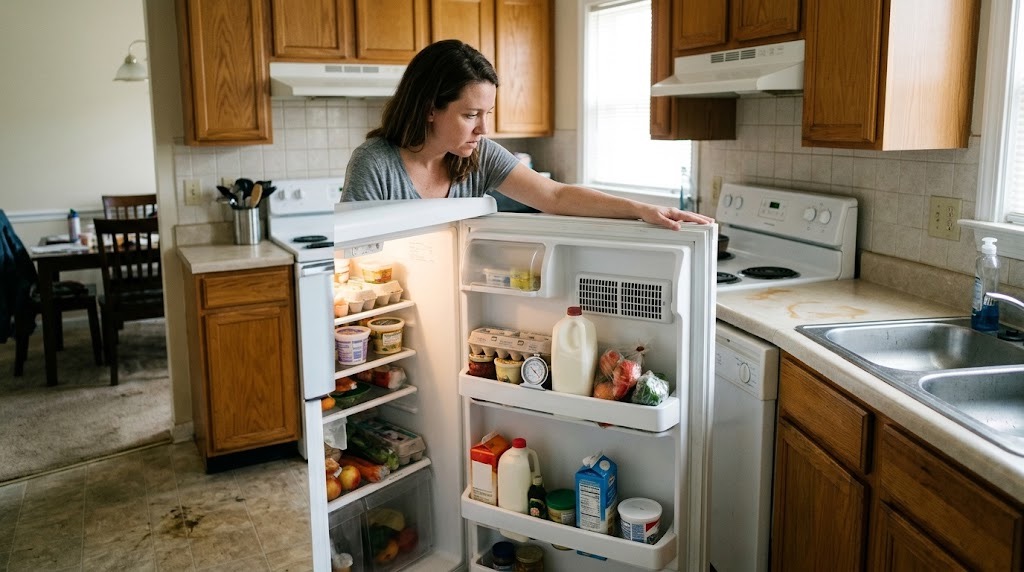
If your refrigerator feels warm, your freezer is thawing, food is freezing in the refrigerator section, or the ice maker or water dispenser has stopped working, start with the doors, controls, airflow, and other normal user checks. Do not pull the refrigerator away from the wall or open panels to troubleshoot it.
This guide covers the safe steps PMI James River residents can take before submitting a maintenance request. If the problem continues, returns, or you cannot proceed safely, report it through the resident portal. For other household issues, use our resident troubleshooting library or the broader Resident Maintenance page.
If the Refrigerator or Freezer Is Not Cooling
First determine whether the refrigerator section, freezer section, or both are affected.
- Keep the refrigerator and freezer doors closed as much as possible while you troubleshoot.
- Check that both doors close completely and that food, containers, or shelves are not preventing them from sealing.
- Look at the temperature controls or display and take a photo of the current settings.
- If you have a refrigerator thermometer, note the actual temperature inside.
- Make sure food is not packed tightly against obvious interior air vents.
- Check for a normal user setting such as Demo, Showroom, Vacation, or another special mode that could affect cooling.
- Note whether the interior light or electronic control panel is operating normally.
Do not pull a full refrigerator out from the wall, remove panels, disconnect it from plumbing, or attempt to access coils or internal components.
Protect Food While the Refrigerator Is Warm
If cooling has stopped, minimizing how often the doors are opened helps hold the remaining cold air. If another working refrigerator or a cooler with ice or ice packs is available, move especially perishable items there as needed.
The USDA advises that during a power outage an unopened refrigerator generally keeps food cold for about four hours, while a full freezer can maintain temperature for about 48 hours and a half-full freezer for about 24 hours. Those are outage guidelines rather than a guarantee for a mechanically failing refrigerator, so use the actual food temperature and condition when available. See the USDA's food-safety guidance for refrigerators and freezers during loss of cooling.
If you have temperature-sensitive medication and you are concerned that its storage temperature is no longer safe, move it to appropriate cold storage if available and contact your pharmacy or prescriber for product-specific storage guidance.
If Food Is Freezing, Frost Is Building Up, or the Refrigerator Runs Constantly
Start with the normal conditions you can see without disassembling anything.
- Check the temperature setting and photograph it before changing it.
- Make sure food is not directly blocking obvious interior air vents.
- Confirm that both doors close fully.
- Look at the visible door gasket for a folded section, food debris, or another obvious obstruction.
- Wipe ordinary debris from the accessible gasket if needed.
- Note where frost or ice is building up and take a photo.
Do not chip ice with a knife or tool, use a hair dryer or other heat source to melt it, or remove interior panels. If the frost returns, a door will not seal normally, or temperature remains abnormal after the basic checks, report the problem.
If the Water Dispenser, Ice Maker, or Filter Is the Problem
If the refrigerator is otherwise cooling normally, check the ordinary dispenser, ice-maker, and filter controls before reporting the issue.
- Check whether the water dispenser, ice maker, or both are affected.
- Look for a filter indicator or other message on the normal control panel.
- Confirm that the ice maker has not simply been switched off through its normal user control.
- If you already know where the refrigerator's user-serviceable water filter is located, confirm that it is fully seated.
Filter designs vary significantly by refrigerator. Whirlpool's Water Filter #4 demonstration is useful only for refrigerators that use that same filter style. Follow your model's normal user instructions rather than forcing, twisting, or removing a filter that does not match the demonstrated design.
Do not pull the refrigerator out, disconnect water tubing, or open panels to investigate a dispenser or ice-maker problem.
If the Refrigerator Is Leaking
If water is actively escaping, stop using the affected dispenser or ice-maker function if that appears to be involved and contain accessible water where you can do so safely.
Water coming from an internal dispenser, ice maker, drain area, or another refrigerator component remains an appliance issue. Water escaping from the refrigerator supply line, shutoff valve, water connection, or another plumbing connection follows our water leak and shutoff guidance.
Do not pull the refrigerator out or disconnect tubing to search for the source. If water is reaching an outlet, cord, or other energized electrical equipment, stop and keep clear of that area rather than continuing to troubleshoot.
What to Include in a Refrigerator Maintenance Request
If the safe checks above do not resolve the issue, the problem returns, or you cannot proceed safely, submit a request through the PMI James River resident portal.
Include:
- whether the refrigerator, freezer, or both are affected;
- when you first noticed the problem and whether it began suddenly or gradually;
- the actual temperature, if you have a refrigerator thermometer;
- a photo of the temperature controls or display;
- any error code or warning light;
- whether the doors close and seal normally;
- photos of unusual frost, ice, or water;
- whether the dispenser, ice maker, or both are affected; and
- any unusual sounds you noticed.
Those details help us understand the symptom and route the request appropriately without asking you to repeat troubleshooting you have already completed.
Published: September 2, 2026