Smart-home technology can make a rental easier to live in and, in some cases, easier to operate. The right device can improve comfort, catch a leak early, simplify access, or provide useful operating information. The wrong one can add batteries, apps, subscriptions, account transfers, Wi-Fi dependencies, privacy questions, and another device that has to be supported at turnover.
For Richmond rental owners, the useful question is not simply whether a device is "smart." It is whether the technology solves a real property, resident, leasing, or management problem. PMI James River's Richmond rental marketing process evaluates features in the context of the property's competitive position, while the Richmond rent-ready baseline separates useful optional improvements from the basic condition every rental needs.
The strongest smart-home upgrades earn their place by making the property more useful or more predictable without creating unnecessary management friction.
Key Takeaways
- Smart thermostats and targeted leak detection have some of the clearest practical uses in Richmond rentals.
- Every connected device needs an ownership plan for accounts, passwords, batteries, updates, troubleshooting, and turnover resets.
- Smart locks can work well, but reliable management access and clean credential control matter more than app features.
- Cameras, video doorbells, and audio-capable devices require more scrutiny because privacy, data, and account control become part of the decision.
- For permanent rental equipment, simple and dependable often beats feature-heavy technology.
In This Guide
- A Smart Device Has to Solve a Real Rental Problem
- Smart Thermostats and Leak Detection
- Access, Security, and Privacy Need More Scrutiny
- Many Smart Devices Are Lower Priority Than They Look
- Use a Seven-Question Smart-Home Test
A Smart Device Has to Solve a Real Rental Problem
Smart technology should earn its place in a rental the same way any other upgrade does. It should solve a specific problem or create a clear resident or operating benefit.
PMI James River uses a practical set of questions when evaluating connected equipment:
- What problem does the device solve?
- Does the benefit primarily help the resident, the owner, management, or some combination of the three?
- Can the device still perform its essential function if the internet connection or cloud service fails?
- Who owns and controls the account?
- Who replaces batteries, handles updates, and responds when the device goes offline?
- Can access, settings, and stored information be reset cleanly between residents?
- Will management still have reliable authorized access for maintenance, inspections, turnover, and emergencies?
- Is the manufacturer likely to continue supporting the product?
Key point: A connected feature should make the rental simpler or more predictable. If an owner gains an app but the property gains another account, subscription, battery, reset procedure, and failure point, the technology may be adding more complexity than value.
Smart Thermostats and Leak Detection Have Clear Use Cases
Smart Thermostats
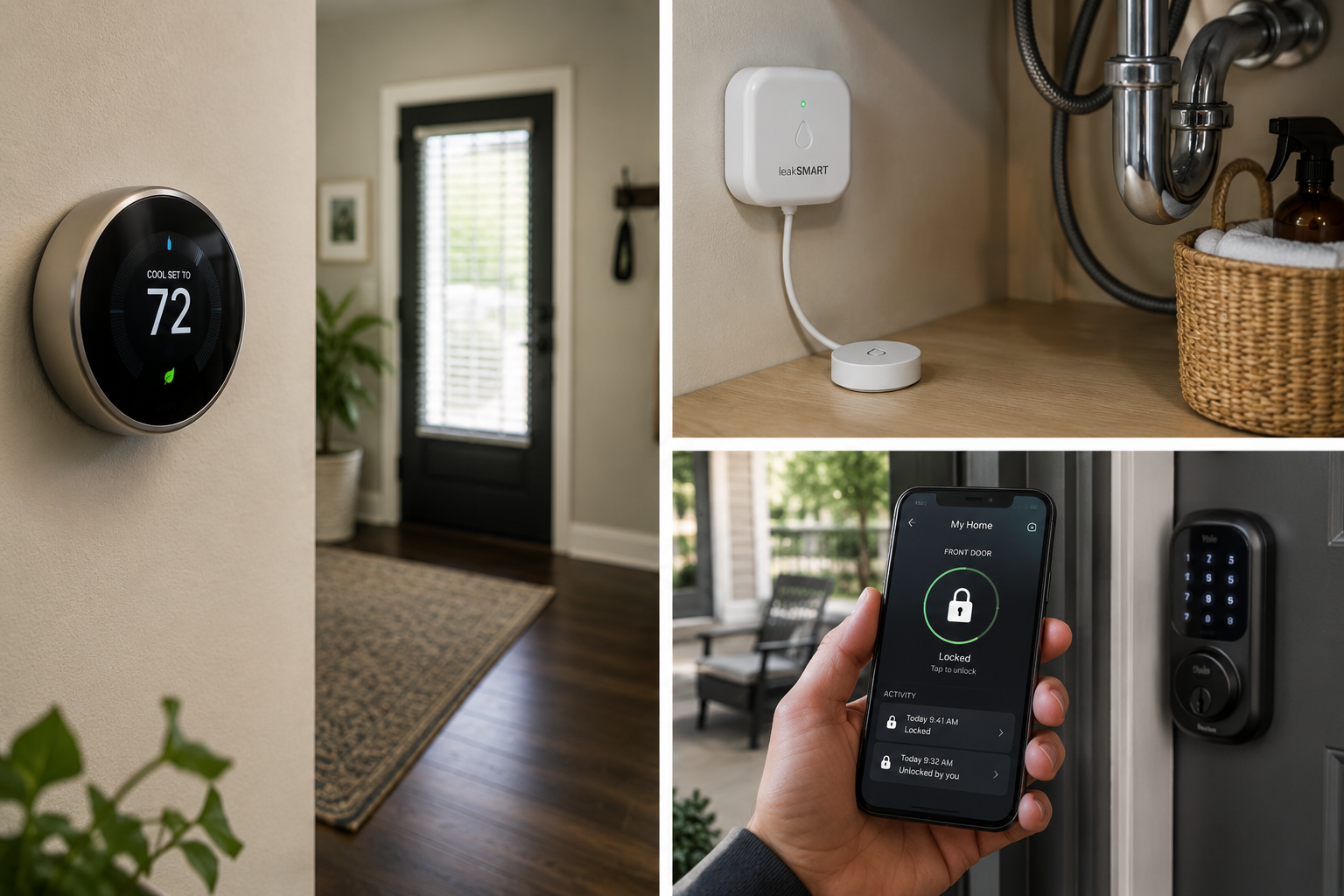
Richmond's long, humid cooling season gives thermostat controls a practical job. A compatible smart thermostat can make scheduling easier, give residents clearer temperature control, and provide useful information about heating and cooling runtime.
ENERGY STAR-certified smart thermostats are independently certified using actual field data to demonstrate energy savings. Compatibility still matters. Heating and cooling equipment, wiring, system type, zoning, and available power can determine whether a particular thermostat is appropriate for a property.
That can be especially relevant across Richmond's varied housing stock. An older Richmond City home may have very different HVAC equipment and thermostat wiring from a newer detached home in Henrico or Chesterfield. The thermostat should fit the actual system rather than being selected solely because a particular model is popular.
There is also a useful reliability test. ENERGY STAR's certification criteria for smart thermostats require certified devices to continue working as basic thermostats even when service connectivity is unavailable. That is the kind of fallback behavior that makes sense in a rental.
Resident control matters too. During an occupied tenancy, the resident needs complete control over the home's temperature subject to the lease and the property's systems. Remote capability can be useful, but it should not turn routine temperature settings into an owner-management task.
Leak Detection and Automatic Shutoff
Leak technology can have an even clearer property-protection purpose.
The EPA's WaterSense program explains that leak-detection and flow-monitoring devices can identify unexpected moisture or irregular water use. Some systems can also help limit further water loss once a problem is detected.
For a rental, the strongest use is usually targeted rather than universal. A sensor near a water heater, washing machine, second-floor plumbing fixture, finished lower level, or another high-consequence location can provide meaningful protection where a concealed leak could otherwise continue unnoticed.
This fits PMI James River's Rent-Ready Standards, which treat approved leak detection as an optional asset-protection measure when the property's history, construction, or potential damage exposure justifies it.
Access, Security, and Privacy Need More Scrutiny
Smart Locks
Smart locks can be useful, but a managed rental needs more from a lock than convenient app access.
Keyless entry can simplify resident access. Temporary codes can help with certain authorized visits. Electronic reprogramming can make credential changes easier with the right system. Those benefits only work when the lock also fits the property's management process.
Important questions include:
- Does the lock operate reliably without internet access?
- What happens when the battery dies?
- Is there a reliable backup or approved alternate access method?
- Who controls the administrator account?
- Can resident credentials be removed without affecting management access?
- Can the lock be reset without depending on a former resident's phone or account?
- Are current keys, remotes, codes, and access devices documented?
- Does every exterior-access point still fit into a practical management access plan?
PMI James River's current Rent-Ready Standard requires owner-installed smart or electronic locks to be discussed and approved if they are going to remain in service. The bar for approval is high: we have spent hours deciphering individual models peculiarities (a cost we now pass on to owners), and even more hours dealing with tenant friction after device failure. The goal is dependable access and clean control of credentials through leasing, maintenance, turnover, emergencies, vendor visits, and resident transitions.
Owner-controlled connected devices are also reviewed before marketing and possession. Accounts, codes, stored permissions, and prior-owner access should not simply carry forward into a new tenancy because the equipment happens to be attached to the property.
An owner considering a permanent smart lock should therefore coordinate with the property manager before installation or before turnover begins. That makes it much easier to determine whether the system actually fits the management process.
Cameras and Video Doorbells
Cameras, video doorbells, and audio-capable devices need a different level of scrutiny because they collect or transmit information rather than simply controlling temperature or detecting moisture.
Account ownership, resident privacy, recording settings, data storage, access to footage, device placement, software support, and cybersecurity all become relevant.
PMI James River's Rent-Ready Standard addresses those issues directly. Interior cameras and audio-recording devices are disabled or removed before marketing. Exterior cameras, video doorbells, alarms, smart locks, and similar connected devices are reviewed so they can be removed, reset, transferred, or specifically approved as appropriate before the resident takes possession.
NIST's smart-home cybersecurity guidance recommends practices such as strong authentication, unique passwords, automatic updates, attention to privacy settings, and retiring devices that no longer receive security updates. Owners considering connected security equipment should account for those ongoing requirements rather than treating installation as a one-time purchase. The NIST smart-home privacy and security guidance provides a useful starting point.
A device collecting information should have a clear purpose, a clear controller, and a clear turnover plan.
Many Smart Devices Are Lower Priority Than They Look
Connected Lighting
App-controlled lighting can be convenient, but most rental rooms already have a simple control system that residents understand immediately: the wall switch.
For permanent rental improvements, dependable LED fixtures, reliable switches, appropriate exterior lighting, and consistent bulb color can create more day-to-day value than a collection of bulbs that require accounts, hubs, pairing, or troubleshooting.
Connected Appliances
A refrigerator, washer, dryer, range, or dishwasher still has one primary job: work reliably.
Wi-Fi features may add convenience, but repairability, parts availability, simple controls, installation requirements, and future service exposure are usually more important in a long-term rental. A connected feature that the resident never activates adds little practical value while still creating another system that may need troubleshooting.
For ordinary long-term rentals, PMI James River generally favors dependable equipment over premium appliances loaded with features that do not materially improve the resident experience or the property's operation.
Voice Assistants and Resident-Owned Devices
Voice assistants, speakers, entertainment systems, connected bulbs, and other personal smart-home equipment are usually better treated as resident technology rather than permanent landlord-supplied equipment.
The resident can choose, configure, secure, update, and remove those devices without making them part of the property's permanent inventory or turnover process.
Use a Seven-Question Smart-Home Test
Before adding a connected device to a Richmond rental, an owner can reduce the decision to seven practical questions.
- What problem does it solve? Comfort, water protection, access, energy use, leasing appeal, or another specific need should be identifiable.
- Does the basic function still work offline? A thermostat should still control temperature. A lock should still secure the door.
- Who owns the account? Decide whether the owner, property manager, or resident controls the device before installation.
- What happens at turnover? Codes, permissions, stored data, Wi-Fi settings, subscriptions, and app access need a clean reset or transfer process.
- Who maintains it? Battery replacement, firmware updates, troubleshooting, and failed hardware need an assigned responsibility.
- Does management access still work? Technology should not make authorized property access more difficult or less reliable.
- Is the benefit worth the complexity? Compare the real resident or operating value against purchase cost, support burden, subscriptions, service life, and eventual replacement.
The same discipline applies to other rental improvements. PMI James River's proactive property maintenance approach focuses on property-specific risks and predictable operating systems. Smart technology is most useful when it strengthens that system rather than creating a second system nobody clearly owns.
Frequently Asked Questions
What Smart-Home Upgrade Makes the Most Sense in a Richmond Rental?
For many properties, a compatible smart thermostat or targeted leak-detection device has a clearer operating purpose than decorative connected technology. The best choice still depends on the property's systems, history, layout, resident experience, and management plan.
Should a Richmond Rental Have a Smart Lock?
It can. The owner should coordinate with the property manager so the lock fits the property's access, credential-control, emergency-entry, battery, and turnover procedures. PMI James River allows owner-installed smart or electronic locks to remain when their ongoing use has been discussed and approved.
Can a Landlord Control a Smart Thermostat Remotely?
Remote capability can be useful, but routine remote adjustment is a different question. During an occupied tenancy, the resident needs normal control over the home's temperature subject to the lease and system requirements. Remote features may be more useful for system information, vacancy periods, or other specifically authorized situations.
Should an Owner Install a Video Doorbell?
Not automatically. A video doorbell adds account, privacy, data, maintenance, cybersecurity, and turnover considerations that a simple sensor does not. The owner should decide who will control the device, what access continues during the tenancy, and how the device will be reset or transferred before making it permanent rental equipment.
Do Smart Devices Increase Rent?
They may improve the appeal of a particular property, but a smart-home label by itself does not establish a reliable rent premium. Rent still depends on the property's location, size, condition, housing type, competing inventory, and the value renters place on the particular feature.
Next Step
The best smart rental is not the home with the most connected devices. It is the home where technology solves a real problem without making access, maintenance, privacy, or turnover harder to manage.
PMI James River helps rental owners in Richmond City, Henrico, Chesterfield, and Hanover evaluate optional property features in the context of the actual home and the management system around it. Before installing a permanent smart lock, thermostat, leak sensor, camera, or other connected device, owners can contact PMI James River to make sure the improvement will work cleanly through leasing, occupancy, maintenance, and turnover.
Published: August 21, 2026
Updated: September 1, 2026