
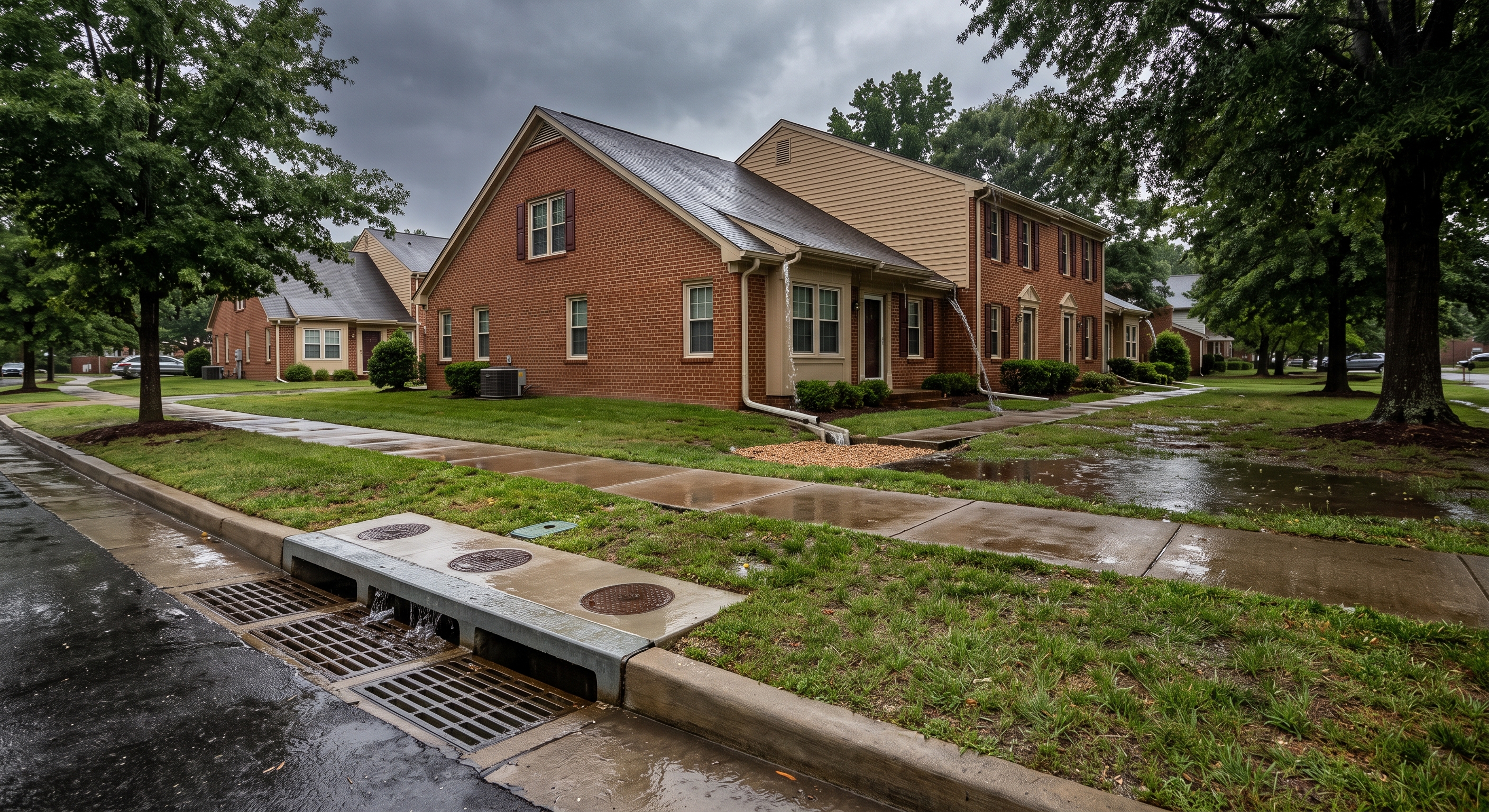
Storm readiness in Chesterfield County depends on knowing where the property ends and the public system begins. A rental may drain through private grading and downspouts, County-maintained drainage facilities in easements, roadside ditches, or a combination of systems. Road hazards add another layer because VDOT owns virtually all public roads in Chesterfield County.
PMI James River handles that distinction inside a broader Richmond rental maintenance system. The same approach runs through our proactive property maintenance framework: map the likely failure path before severe weather compresses the response timeline.
Key Takeaways
- Chesterfield County maintains stormwater drainage facilities within County easements, while VDOT owns virtually all public roads in the county.
- Owners should distinguish on-lot drainage failures from County drainage-system concerns and road hazards before deciding who needs to act.
- Chesterfield's stormwater network includes hundreds of miles of pipes, ditches, and paved channels, so public drainage context can materially affect a property's storm response.
- Power outage reporting depends on the property's serving utility. Chesterfield County's storm guidance identifies both Dominion Energy and Southside Electric Cooperative.
- After water intrusion, stabilize the source, begin drying promptly, and document what changed before the next weather event obscures the timeline.
In This Guide
- Understand Who Controls The Drainage Path
- Prepare The Property Before Heavy Rain
- Separate County Drainage From VDOT Road Hazards
- Plan For The Property's Serving Utility
- After The Storm: Stabilize, Dry, And Document
- Use Triggered Property Evaluations
Understand Who Controls The Drainage Path
Chesterfield County's Drainage Maintenance Operations maintains drainage facilities within County easements. The County reports maintaining roughly 107 miles of drainage facilities in an average year and describes a system serving more than 10,000 addresses, nearly all residential.
The broader stormwater system is larger still. Chesterfield's Stormwater Utility describes several hundred miles of pipes, ditches, and paved channels. For a rental owner, the practical lesson is not to assume every ditch or pipe at the edge of a property has the same maintenance responsibility.
The broader Richmond Metro storm-readiness framework covers the regional operating sequence. Chesterfield adds a jurisdiction-specific step: identify whether the problem is on the rental property, inside a County drainage easement or stormwater facility, or connected to a public road.
Prepare The Property Before Heavy Rain
Storm preparation still begins at the structure. Clear accessible roof valleys, gutters, downspout outlets, and private drains when debris restricts flow. Confirm downspouts release water away from vulnerable foundation areas. Check crawlspace openings, basement walls, low doors, exterior penetrations, and any location with prior seepage or staining.
Then follow the water beyond the house. Does runoff cross the yard toward the structure? Does a ditch or swale appear blocked? Is water ponding near the foundation or driveway? Is the drainage feature inside an easement? A few minutes spent identifying the route before the storm can prevent a confused response after water starts moving.
The Richmond rental maintenance checklist covers recurring maintenance execution. Storm preparation should use the property's history to decide which parts of that checklist need immediate attention.
Separate County Drainage From VDOT Road Hazards
Chesterfield's public-response structure makes classification important. The County accepts reports for drainage problems and blocked storm drains through Environmental Engineering and Drainage Maintenance. Road conditions are different. Chesterfield County states that VDOT owns virtually all roads in the county and is responsible for road maintenance.
That means a downed tree blocking a public road, a road hazard, and a drainage problem in a County easement may need different public contacts. The County's storm information page directs road hazards and downed trees affecting roadways to VDOT.
None of those public channels replaces property mitigation. If a roof is leaking, a downspout is disconnected, or water is entering through a crawlspace or basement, the property manager still needs to stabilize and document the rental condition. Repeated patterns belong in the Richmond rental maintenance seasons plan before the next storm.
Plan For The Property's Serving Utility
Chesterfield owners should not assume every property uses the same electric utility. The County's storm guidance identifies both Dominion Energy and Southside Electric Cooperative for outage reporting. The resident should check the serving utility's outage status before a neighborhood outage is treated as a property maintenance failure.
The property-specific question comes next: what stops working when power is lost? Sump pumps, sewage ejectors, well pumps, condensate pumps, refrigerators, and other powered equipment can create secondary damage or service problems. A known pump or well dependency should be recorded before severe weather so the response does not begin with basic discovery.
For regional hazard information, the National Weather Service Wakefield preparedness page provides current resources for flooding, severe thunderstorms, tropical weather, winter weather, and other hazards.
After The Storm: Stabilize, Dry, And Document
Active water entry, sewage, a structural opening, a serious electrical concern, or a fallen tree affecting the structure needs stabilization first. Once the source is controlled, drying becomes time-sensitive. The EPA's current moisture and mold guidance recommends drying wet or damp materials within 24 to 48 hours when practical.
Document the property and the surrounding condition separately. Photograph interior water, stains, roof or siding damage, ponding, blocked ditches, displaced downspouts, debris, and tree damage. Record what the resident saw, when it started, and whether the public road or drainage system was also affected.
Virginia Code § 55.1-1220 remains the landlord-maintenance baseline. It requires landlords to make repairs needed to keep rental premises fit and habitable, maintain supplied building systems in good and safe working order, and maintain the premises to prevent moisture accumulation and mold growth.
Use Triggered Property Evaluations
Not every Chesterfield rental needs an interior evaluation after every storm. Use evidence-based triggers: new water intrusion, new staining, visible exterior damage, a resident report, a failed power-dependent system, or a known vulnerability that the storm directly tested.
That keeps post-storm work focused on changed conditions rather than automatic entry. Our guide to rental property evaluation frequency and triggers explains how event-based evaluations fit into normal condition tracking.
Chesterfield County Storm Readiness FAQ
Who Handles Drainage Problems In Chesterfield County?
It depends on the drainage feature. Chesterfield County maintains stormwater drainage facilities within County easements and provides channels for drainage complaints. Property-level grading, gutters, downspouts, and private drainage still require a property response.
Who Handles A Tree Or Hazard Blocking A Chesterfield Road?
Chesterfield County states that VDOT owns virtually all roads in the county, and the County's storm guidance directs roadway hazards and downed trees affecting roads to VDOT. A tree that damages the rental itself also creates a separate property-maintenance issue.
Which Utility Should A Resident Contact During A Power Outage?
Use the utility that serves the specific property. Chesterfield County's storm guidance identifies Dominion Energy and Southside Electric Cooperative. Property management becomes involved when the issue is isolated to the rental or a property-specific system fails during or after the outage.
Conclusion
Chesterfield storm readiness improves when ownership and response boundaries are clear before the weather arrives. The rental's drainage path, County drainage facilities, VDOT road responsibility, and the property's serving utility can all matter during one event. Classifying them correctly helps the owner protect the property without sending the wrong problem to the wrong responder.
Next Step
PMI James River can help Chesterfield County owners connect property history, drainage observations, resident reports, vendor response, and post-storm documentation inside a consistent rental maintenance process.
Published: August 23, 2026