
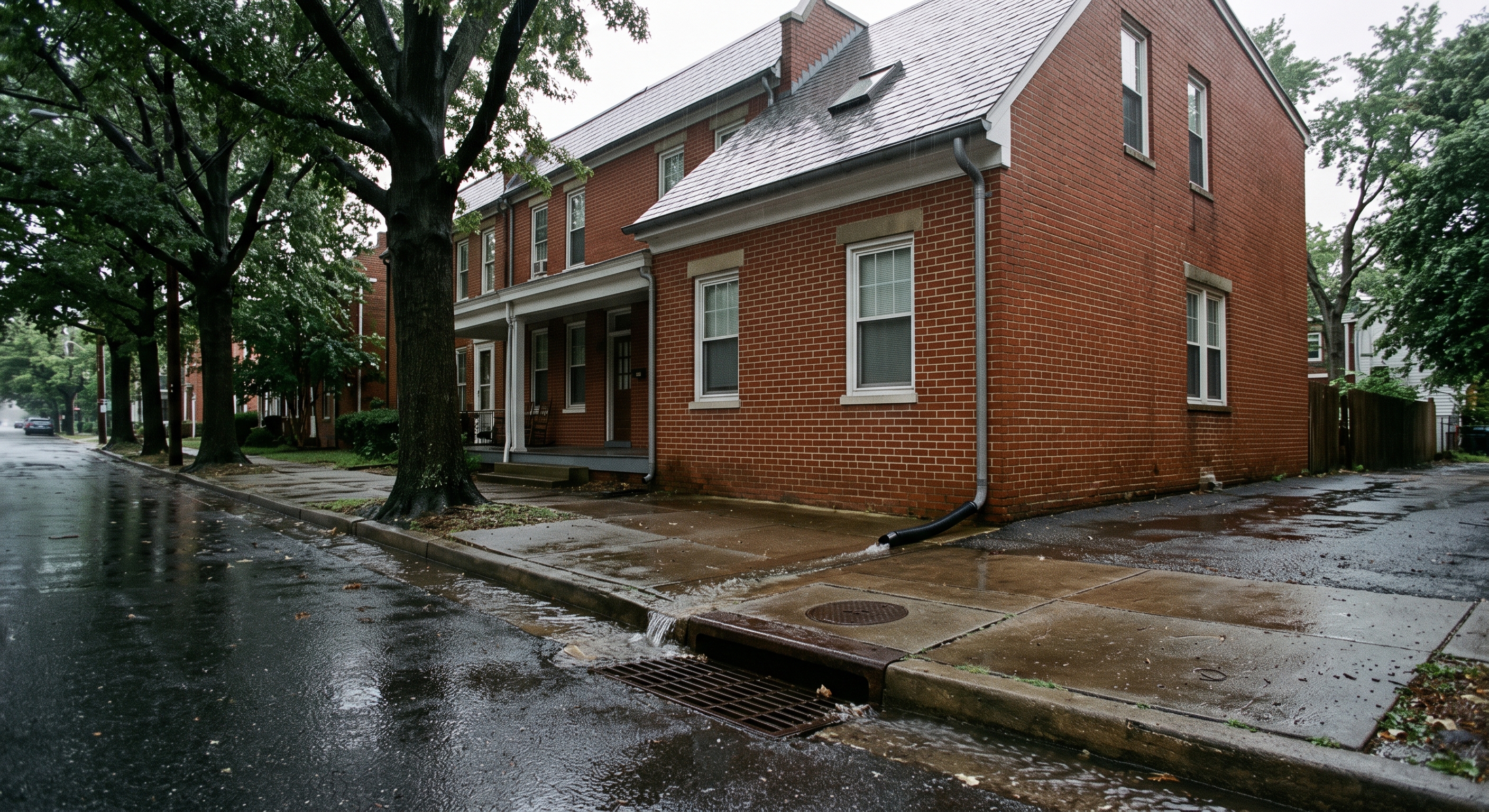
Storm readiness in Richmond City requires two layers of thinking at the same time. The rental itself has gutters, downspouts, roof transitions, grading, basements, crawlspaces, drains, trees, and power-dependent equipment. The City also has public stormwater and sewer systems that affect how water moves beyond the property. A good plan separates those systems instead of assuming every drainage problem has the same cause.
PMI James River handles that distinction inside a broader Richmond rental maintenance system. The operating principle also follows our proactive property maintenance framework: identify the property-specific failure path before a storm removes time and vendor flexibility.
Key Takeaways
- Richmond City uses more than one public drainage model. Central portions of the city are served by a combined sewer system, while much of the rest is served by a municipal separate storm sewer system.
- Public stormwater infrastructure does not replace property-level drainage. Owners still need to know how water leaves the roof, crosses the lot, and reaches or avoids vulnerable parts of the structure.
- Basements, low openings, roof transitions, clogged inlets, and power-dependent pumps deserve more attention when the property already has a history of water entry.
- After water intrusion, stabilization should be followed by prompt drying and documentation. EPA guidance recommends drying wet or damp materials within 24 to 48 hours when practical.
- City drainage concerns and property maintenance failures should be reported through the correct channel so neither response is delayed.
In This Guide
- Understand Richmond City's Two Drainage Contexts
- Prepare The Property's Water Path
- Separate City Drainage From Property Drainage
- Plan For Power Loss Before It Matters
- After The Storm: Stabilize, Dry, And Document
- Use Triggered Property Evaluations
Understand Richmond City's Two Drainage Contexts
Richmond City is unusual because the public system is not uniform. The City explains that the older central portion is served by a combined sewer system covering roughly 12,000 acres, or about one-third of the city. That system carries both wastewater and stormwater. Other parts of Richmond are served by the City's municipal separate storm sewer system, which carries stormwater separately to local waterways.
For a rental owner, that distinction is useful context, but it does not diagnose water inside the property. A basement stain can still begin with a roof leak. Foundation seepage can still start with a short downspout or water collecting beside the house. A blocked public inlet can matter at the street while a clogged gutter creates a separate problem at the structure.
The broader Richmond Metro storm-readiness framework covers the regional operating sequence. Richmond City adds a public-system question: is the condition being created on the rental property, in the public drainage system, or by both at the same time?
Prepare The Property's Water Path
Before heavy rain, start at the structure and work outward. Clear accessible roof valleys, gutters, downspout outlets, and property drains when debris is restricting flow. Confirm downspouts discharge away from vulnerable foundation areas. Check any basement stairwell, window well, areaway, crawlspace opening, low door, or other opening that has taken on water before.
Prior work orders matter more than a generic storm checklist. If one rear corner repeatedly holds water, one gutter repeatedly overflows, or one basement wall has a seepage history, that location should move to the top of the pre-storm review. PMI James River uses the same history-based approach in the Richmond rental maintenance checklist.
Owners should also treat seasonal debris as part of storm preparation. Richmond's Stormwater Utility specifically emphasizes keeping leaves and debris out of storm drains. On the rental itself, the same principle applies to gutters, downspouts, and accessible drains: water needs a clear route before the rain starts.
Separate City Drainage From Property Drainage
When water is collecting at or near a Richmond City rental, classify the problem before sending everyone toward the same fix. Water overflowing from the roof edge points toward the property. A displaced downspout extension points toward the property. A street inlet that is blocked, damaged, or not accepting water may require City attention. Both conditions can exist during the same storm.
Richmond Department of Public Utilities directs stormwater service requests, including certain catch-basin and storm-drain concerns, through RVA311 and DPU service channels. Reporting the public condition does not eliminate the need to protect the rental. The owner or manager should still document what is happening on the lot, keep safe property drainage paths open, and respond to active water entry.
This is where property history pays off. If the same rain pattern creates the same water path more than once, the issue should move from storm response into planned maintenance. The Richmond rental maintenance seasons guide is the better place to schedule recurring work before the next event.
Plan For Power Loss Before It Matters
A neighborhood outage and a property electrical failure are different maintenance events. Residents should first check the serving utility's outage information when power is lost. If service is restored around the property but the rental remains without power, or if a property-specific system does not recover correctly, property-level troubleshooting may be needed.
The owner also needs to know which systems become vulnerable when electricity stops. A sump pump, sewage ejector, condensate pump, powered drainage component, refrigerator, or other equipment can turn a routine outage into a second problem. The right contingency depends on the property. A basement with a known sump dependency needs a different storm plan from a property with gravity drainage and no history of water accumulation.
For current severe-weather information affecting Richmond City, the National Weather Service Wakefield preparedness page provides regional guidance for thunderstorms, flooding, tropical weather, winter weather, and other hazards.
After The Storm: Stabilize, Dry, And Document
Active water entry, a structural opening, sewage, a serious electrical concern, or a fallen tree affecting the structure needs immediate stabilization. Once the source is controlled, drying becomes time-sensitive. The EPA's current moisture and mold guidance recommends drying wet or damp materials within 24 to 48 hours when practical.
Document the change before the next rain makes the timeline harder to reconstruct. Photograph water locations, stains, damaged roofing or siding, displaced downspouts, ponding, debris at drains, and fallen limbs. Record when the resident first noticed the condition and whether water was still entering at the time of the report.
Virginia's maintenance baseline also remains in effect after a storm. Virginia Code § 55.1-1220 requires landlords to make repairs needed to keep rental premises fit and habitable, maintain supplied building systems in good and safe working order, and maintain the premises to prevent moisture accumulation and mold growth.
Use Triggered Property Evaluations
Not every Richmond City rental needs an interior visit after every storm. The better trigger is evidence: a resident report, visible exterior damage, a known leak or seepage history, a power-dependent system that failed, or a storm that directly tested a documented vulnerability.
A triggered evaluation answers one practical question: did this event expose a condition that should be documented or corrected before the next one? That is the same risk-based logic used in our guide to rental property evaluation frequency and triggers.
Richmond City Storm Readiness FAQ
Does Richmond City's Public Drainage System Handle Water Problems On A Rental Property?
Not automatically. City infrastructure can affect street and public drainage, but gutters, downspouts, grading, private drains, roof conditions, and water entry at the rental remain property-level issues. The first step is to identify where the failure path begins.
Why Does The Combined Sewer System Matter To A Rental Owner?
It helps explain why stormwater context differs across Richmond City. Central portions use a combined system while much of the rest of the city uses separate stormwater infrastructure. That public-system context can affect what is happening beyond the lot, but it should not be used as a substitute for diagnosing the rental itself.
When Should A Storm Trigger A Property Evaluation?
Use a risk trigger rather than the weather event alone. New water entry, new staining, visible exterior damage, a failed property-specific system, or a known vulnerability that was directly tested are stronger reasons to evaluate than a storm occurring somewhere in the city.
Conclusion
Richmond City storm readiness works best when the owner separates three things: the rental's own water path, the surrounding public drainage context, and the systems that depend on electricity. That separation makes reporting faster, diagnosis clearer, and repeat problems easier to move into planned maintenance.
Next Step
PMI James River can help Richmond City owners turn drainage history, resident reporting, vendor response, and post-storm documentation into a consistent rental maintenance process instead of rebuilding the response after every storm.
Published: August 23, 2026