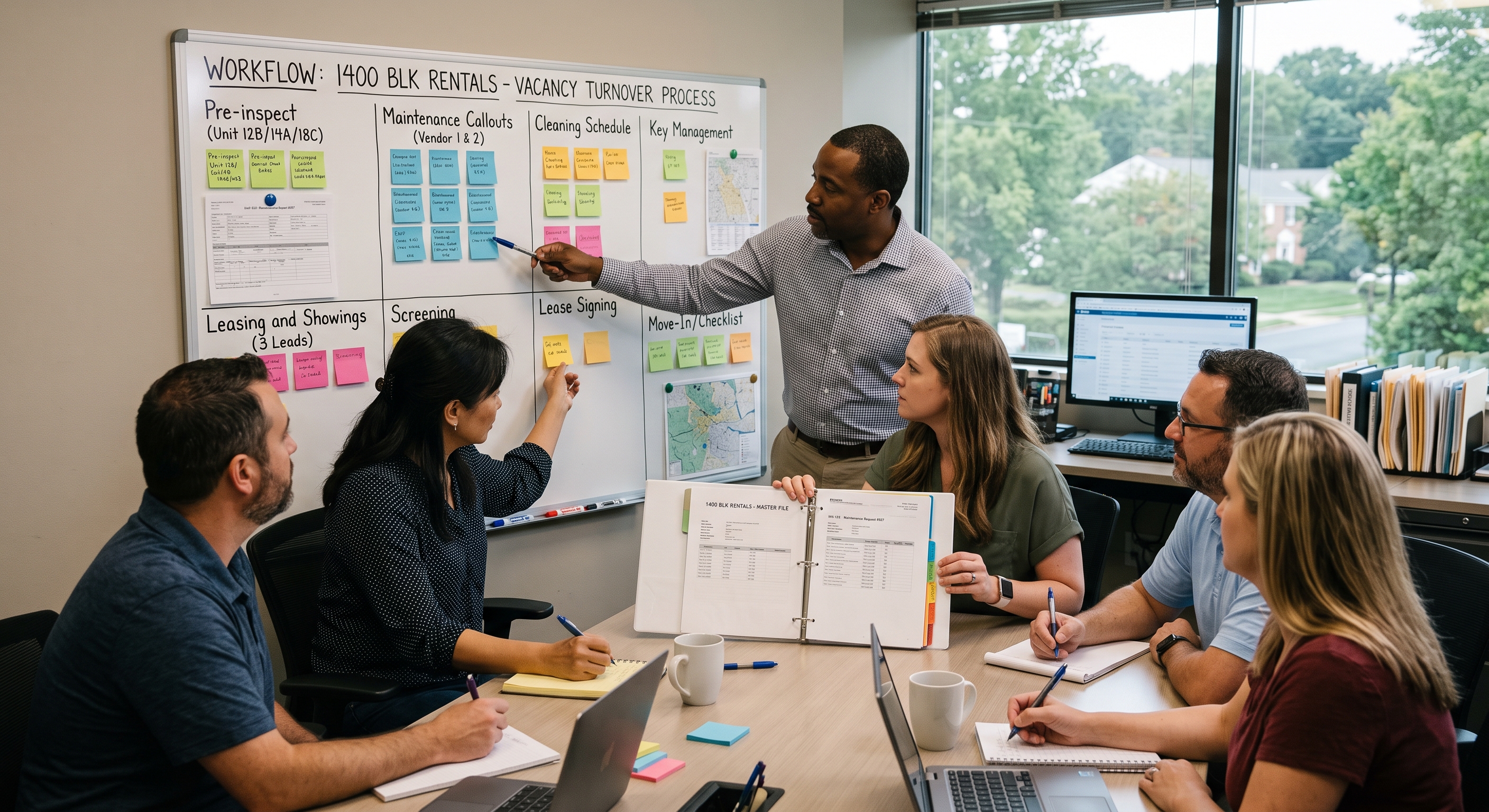
A rental owner may imagine that one property manager handles everything from the lease to a leaking faucet to the monthly statement. Some companies do operate close to that model. Others divide leasing, maintenance, accounting, renewals, resident communication, and owner support among specialists or smaller teams.
For an owner, the internal org chart is less important than the result. PMI James River's owner resources show the different functions involved in managing a rental, while the broader guide to why Richmond owners hire a property manager explains why those functions are valuable when they operate as one accountable system.
The practical question is not whether a company uses one manager, departments, pods, specialists, or a hybrid. It is whether the right person handles each issue, the property history follows the work, and somebody remains responsible for getting the issue to resolution.
Key Takeaways
- Property management companies divide work in several legitimate ways.
- One manager handling everything can provide continuity, but it can also create dependence on one person's capacity and availability.
- Specialists can provide deeper expertise, but poor handoffs can fragment the owner experience.
- A single point of contact is useful only when that person or team can actually own the issue through resolution.
- Company size is not a reliable quality measure. Accountability, records, specialization, backup coverage, and follow-through matter more.
How Do Property Management Companies Divide the Work?
A property management company is the organization behind the service, not merely one employee. That gives companies several ways to divide the recurring work.
| Structure | How it works | Potential strength | Potential weakness |
|---|---|---|---|
| Primary or generalist manager | One manager handles most owner and property functions. | Strong continuity and one person who knows the property well. | Too much knowledge or workload can become concentrated in one person. |
| Specialist departments | Leasing, maintenance, accounting, renewals, and other functions are handled by specialists. | People can develop deeper expertise in their functions. | The owner can get bounced between teams if responsibility and records are weak. |
| Small cross-functional team | A small group supports a defined set of properties. The industry sometimes calls this a pod. | Can combine specialization, shared context, and backup coverage. | Different teams can develop inconsistent practices if company-wide systems are weak. |
| Hybrid | Some functions remain specialized while one person or team owns the broader client relationship. | Can combine specialist expertise with relationship continuity. | Responsibility can become unclear if the company has not defined who owns each issue. |
No one structure guarantees good service. The practical question is what happens as an issue moves from one function to another.
What Matters More Than the Company's Org Chart?
Issue ownership.
Consider a repair that begins with a resident report, requires a maintenance coordinator, produces a vendor invoice, appears on the owner statement, and later raises a question about whether the resident should be charged. Several people may legitimately touch that file.
The owner should not have to coordinate those people or repeatedly explain the property history.
A stronger operating model makes sure:
- the issue reaches the right person;
- the property history and previous decisions are available;
- specialists can perform the work they are best equipped to handle;
- somebody remains responsible for the next step;
- material decisions reach the owner when needed; and
- the issue reaches a documented conclusion.
This is one reason full-service property management should be evaluated as a connected operating system. The owner should not become the person responsible for making the company's internal departments communicate with one another.
Is a Single Point of Contact Always Better?
Not necessarily.
A single point of contact can be convenient because an owner knows where to start. But the value disappears if that contact cannot resolve the question, has to repeatedly chase other departments, or simply forwards the owner from one person to the next.
Responsiveness should therefore be judged by more than whether somebody answers the phone.
A useful test is:
- Did the company understand the question?
- Did it identify who owns the next step?
- Did the relevant person have the information needed to act?
- Did the owner receive a useful answer or completed action?
- Was the result preserved in the property record?
An owner may speak with different people for leasing, maintenance, and accounting and still receive excellent service if those functions are connected. Conversely, an owner can have one named property manager and still receive poor service if that person lacks backup, records, authority, or follow-through.
Does a Smaller Property Management Company Provide Better Service?
Not automatically. Company size is a poor shortcut for judging service quality.
A small company can provide excellent continuity and attention. It can also be disorganized or overly dependent on one person. A larger company can create frustrating departments and handoffs. It can also provide deeper specialization, stronger backup coverage, and more durable systems.
The more useful question is whether the operating model preserves accountability as the company grows.
Owners should look for:
- usable property records;
- clear responsibility for open issues;
- competent specialists where specialization helps;
- backup when a normal contact is unavailable;
- consistent procedures across the company; and
- reliable follow-through from intake to closeout.
Where Can Team Structures Break Down?
Different structures tend to fail in different ways.
Too Much Depends on One Person
A primary-manager model becomes fragile when the property history, vendor knowledge, owner instructions, and open issues live mostly in that person's memory. Vacation, illness, turnover, or simple workload can interrupt service.
Too Many Handoffs
A departmental model becomes frustrating when an issue crosses functions and every department treats its piece as complete without anyone owning the overall result.
A Small Team Becomes Its Own Silo
A cross-functional team can preserve context well, but the company still needs consistent standards and records. Otherwise, owners can receive different experiences depending on which team happens to manage the property.
A Hybrid Model Has Unclear Responsibility
A hybrid can work very well when the company clearly separates specialist work from relationship ownership. It works poorly when neither the specialist nor the relationship manager knows who is responsible for closing the issue.
Why Property-Specific Context Matters in Richmond
The same company structure may handle different Richmond-area properties differently because the properties themselves create different operating needs.
An older Richmond City home may have a longer plumbing or electrical history that a maintenance specialist needs to see before dispatching a vendor. A Henrico townhouse may have association requirements affecting access, parking, exterior work, or resident responsibilities. A Chesterfield single-family rental may have different warranties, systems, exterior responsibilities, or vendor coverage.
The company does not need the same employee to remember every detail personally. It needs a record and workflow strong enough that the relevant person can see the details when they matter.
What Should Owners Ask Before Hiring?
Instead of asking only, "Who is my property manager?" ask questions that expose how the company actually operates:
- Who is my normal point of contact?
- Who handles leasing?
- Who handles maintenance requests and vendor coordination?
- Who handles owner accounting questions?
- Who handles renewals and lease administration?
- What happens when my question crosses more than one department?
- Who owns an issue until it is resolved?
- Where is the property's history kept?
- Who covers the property when the normal contact is unavailable?
- Which decisions are made routinely and which come back to me?
The first few months after management begins are where those answers become visible. What to Expect After Hiring a Property Manager in Richmond explains how the owner experiences that handoff once the company begins operating the rental.
The Bottom Line
Owners do not need to choose between a "pod company," a "department company," or a "portfolio company." Those are internal operating structures.
The better standard is whether the company can combine the right people, reliable records, clear authority, backup coverage, and issue ownership into one coherent owner experience.
After that operating model is clear, the next comparison is economic. How Much Does Property Management Cost in Richmond, VA? explains how to compare the recurring and event-driven costs of that management system.
Published: August 29, 2026