
```html id="sqln8u"
Cabinet doors, drawers, shelves, counters, vanities, closet rods, and built-in fixtures can fail in very different ways. Some problems are simple enough for an ordinary resident adjustment. Others involve an unstable mounted component, damaged material, or active water and should stop at containment and reporting.
For PMI James River residents in the Richmond Metro, start with the simplest visible cause and use only low-risk, reversible steps. Do not force a component that is stuck or try to remount something that is pulling away from the wall or cabinet structure.
If a Cabinet Door or Drawer Is Stuck
Look for a plainly visible stored item that is blocking the door or drawer. If the item is readily accessible and can be removed without force or consequential disassembly, remove it and try the door or drawer normally once.
If it still does not operate normally, stop. Do not pry the door, kick the drawer, remove the slide assembly, or force it past resistance.
If a Knob, Pull, or Cabinet-Door Hinge Screw Is Loose
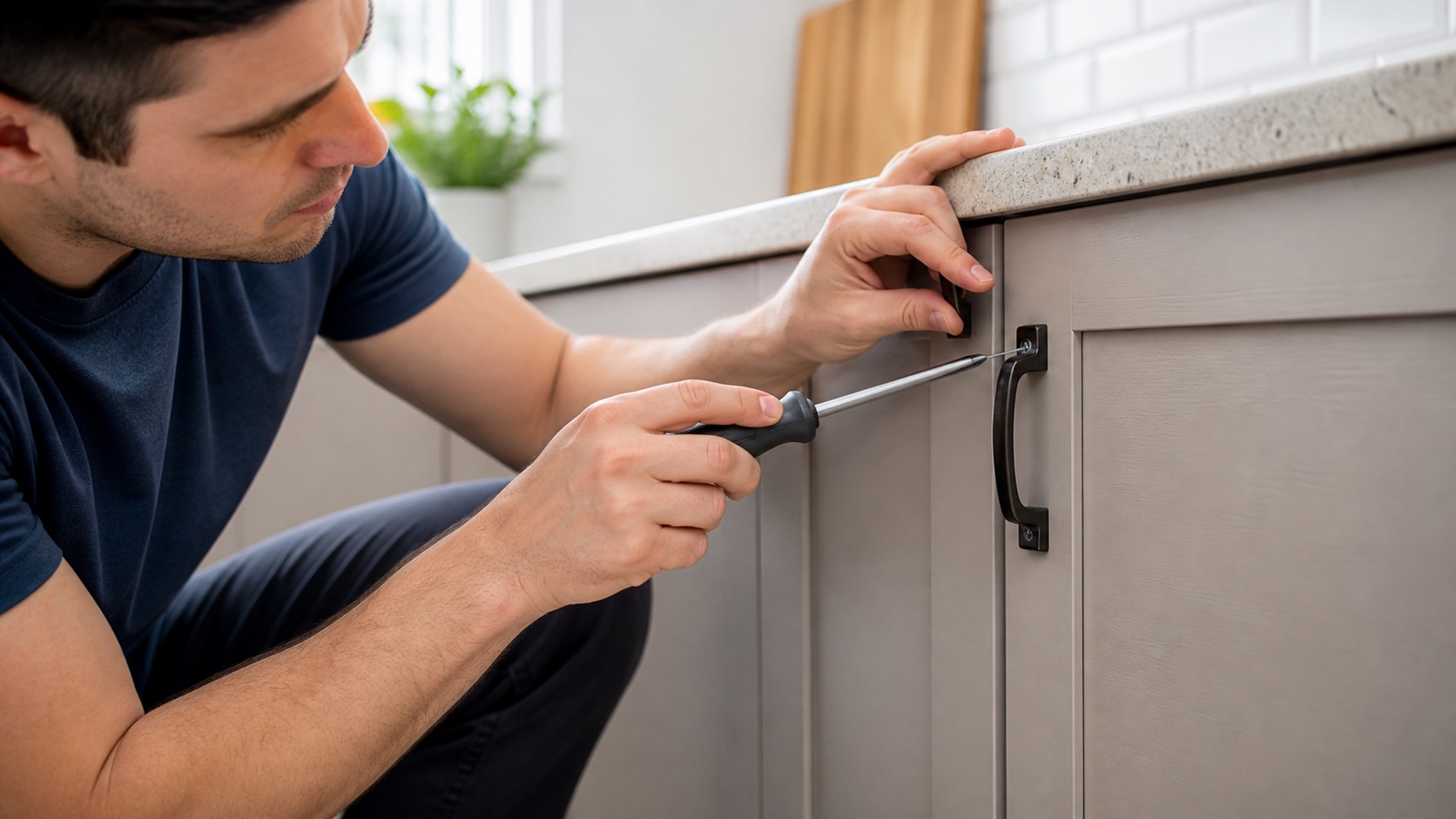
If the cabinet door or drawer is otherwise stable and the problem is limited to a plainly visible loose knob, pull, or hinge mounting screw, you can try a simple adjustment:
- Use the hand screwdriver that matches the screw head.
- Hold the hardware or cabinet door normally so it is not twisting while you work.
- Turn the existing screw clockwise with light hand pressure until it is snug.
- Stop once the screw is seated. Do not keep tightening for extra force.
- Open and close the door or drawer normally once to see whether ordinary operation has been restored.
Do not use a drill or impact driver, add new fasteners, move a screw to a different location, or keep turning a screw that spins without tightening. Stop if the screw is stripped, will not seat, the surrounding wood or cabinet material is split or crumbling, or the door or component remains unstable.
If a Cabinet, Shelf, Vanity, or Closet Fixture Is Unstable
A mounted component that is sagging, pulling away, or at risk of falling is different from one loose hardware screw. Stop placing weight on it.
If lightweight stored items can be removed without standing beneath, pulling on, or otherwise stressing the unstable component, remove them to reduce the load. Otherwise, leave the area alone and keep people and pets clear.
Do not add wall anchors, relocate fasteners, brace the component, or attempt to remount it as a resident troubleshooting step.
If a Countertop Is Loose, Cracked, or Separating
Do not place extra weight on a counter that is shifting, separating from its cabinet base, or unsupported at an edge. Photograph the gap, crack, or damaged area from a normal position.
If the countertop has a sharp broken edge, avoid that portion of the surface until the condition can be reviewed.
If Water Is Leaking Under a Sink or Vanity
An active leak is a water problem first. Our LIVE Resident Maintenance Plumbing & Water section includes sink shutoff guidance and our selected How to Stop a Leak Under a Cabinet video.
If the closest shutoff valve is readily accessible and can be operated normally, turn it clockwise to stop the water. Do not force a seized valve. Catch or wipe up water that you can reach safely and move nearby belongings out of the wet area.
Once the water is contained, photograph any swelling, staining, separation, or other visible cabinet or counter damage. If nearby flooring is lifting, buckling, or becoming soft, see Flooring & Carpet Problems.
If the Problem Continues
If reasonable resident troubleshooting does not resolve the issue, the condition returns or continues, or you cannot proceed safely, submit a maintenance request through the Rentvine resident portal.
Include the room and component, clear photos or a short video, what ordinary action triggers the problem, what troubleshooting you already tried, whether anything is pulling away or could fall, and whether water is present or was recently present.
For other household problems, use the PMI James River resident troubleshooting library.
Published: September 2, 2026