
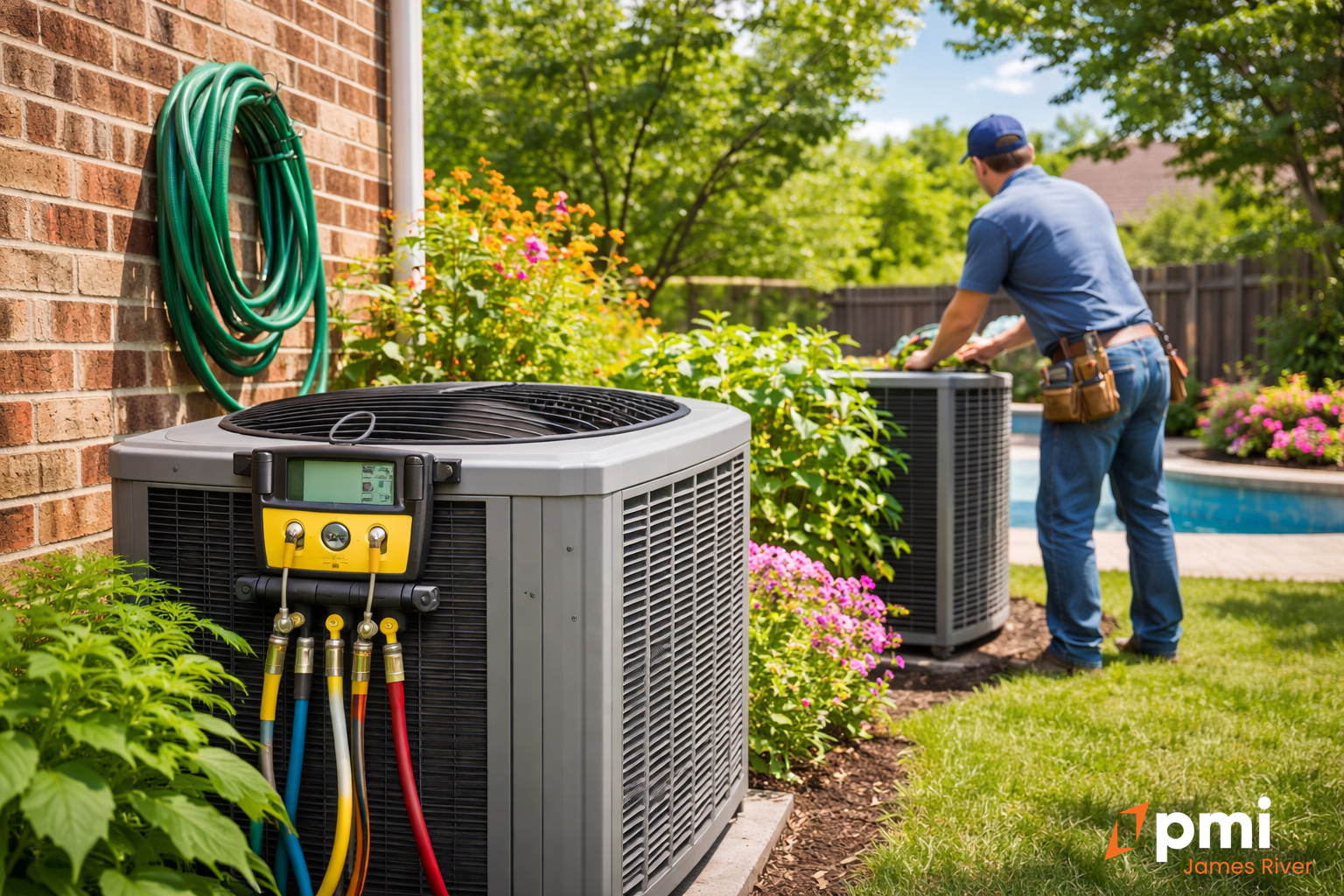
The best way to prevent summer HVAC and humidity problems in a Richmond rental is to manage moisture, condensate, airflow, and cooling performance as one system. The practical priorities are straightforward: keep indoor humidity controlled, make sure condensate drains safely, service cooling equipment before peak demand, keep filters from restricting airflow, and collect useful temperature and airflow information before a technician is dispatched.
That matters because the same complaint can have different causes. An older Richmond City home with long duct runs may develop a room-by-room comfort problem. A crawlspace property in Hanover may show moisture below the living space before anything appears indoors. Multi-level homes in Henrico and Chesterfield can expose distribution problems when cooling demand rises.
PMI James River handles these issues through a documented maintenance coordination process that separates water risk, equipment performance, and comfort complaints instead of treating every summer call as the same problem. That approach fits our broader proactive maintenance framework: catch manageable conditions early, document what the system is actually doing, and avoid turning a routine service call into a peak-season emergency.
Key Takeaways
- Humidity and condensate control come first because water can turn a cooling complaint into building damage.
- A return-to-supply temperature split of roughly 15 to 20°F is a useful cooling rule of thumb, but it is a screening check, not a stand-alone diagnosis.
- The 15 to 20°F rule refers to return air versus supply air. It does not mean an air conditioner can only cool a house 20°F below the outdoor temperature.
- During extreme heat, a system can produce a reasonable temperature split and still struggle to hold the thermostat setpoint if the building load exceeds the cooling capacity being delivered.
- ENERGY STAR recommends annual pre-season cooling maintenance and monthly filter inspection, cleaning, or replacement.
- Good intake and closeout notes reduce repeat dispatch. Record the symptom, the conditions, what was found, what changed, and how the result was verified.
In This Guide
- Why Summer Needs a Different Maintenance Plan
- Tier 1: Control Humidity and Condensate
- Tier 2: Keep the Cooling System Stable
- What the 15 to 20 Degree Rule Actually Tells You
- How to Triage "Not Keeping Up" Complaints
- Common Summer Mistakes Owners Can Prevent
Why Summer Needs a Different Maintenance Plan
Summer HVAC work in Richmond is not simply about whether the air conditioner turns on. Cooling equipment is also removing moisture, producing condensate, moving air through the home, and operating during the season when service calendars are under the most pressure. ENERGY STAR recommends pre-season cooling checkups in part because contractors become busier once summer arrives.
The property configuration changes what deserves attention. Richmond City's older housing stock can combine compact mechanical spaces, additions, finished upper levels, and long duct runs. Hanover rentals with crawlspaces deserve extra attention during long humid stretches. In Henrico and Chesterfield, multi-level layouts can make a distribution problem feel like a whole-system failure even when the equipment is still producing cold air.
The Richmond seasonal maintenance plan provides the year-round timing framework. Summer is where moisture control, cooling reliability, and service timing need to work together.
Tier 1: Control Humidity and Condensate
Summer Tier 1 is moisture control. The U.S. Environmental Protection Agency recommends keeping indoor relative humidity below 60 percent, ideally between 30 and 50 percent. EPA also recommends addressing wet materials promptly and controlling the source of moisture. EPA moisture-control guidance notes that moisture problems can damage building materials as well as affect indoor air quality.
For a rental owner, the useful question is not simply whether the air conditioner is making cold air. It is whether the system is removing moisture and disposing of condensate predictably without creating a second problem.
- Condensate drain: Is the line open, routed correctly, and carrying water away?
- Drain pan: Is there staining, rust, debris, or evidence of a prior overflow?
- Overflow protection: If a float switch or secondary drain is installed, was its function actually checked?
- Discharge location: Is condensate ending up where it will not keep siding, framing, or a foundation area wet?
- Indoor humidity: Is elevated humidity temporary, or does it persist while the cooling system is operating normally?
Key point: Water around an air handler is a moisture-control event first. Prevent further wetting, identify the source, verify the condensate path, and document that drainage is working before the ticket is considered complete.
Crawlspaces and basements deserve the same mechanism-first thinking. A musty odor, damp insulation, sweating ductwork, or recurring condensation does not prove one cause. It does show that moisture needs to be traced before cosmetic work is treated as the solution.
Tier 2: Keep the Cooling System Stable
Summer Tier 2 is system stability. The goal is to reduce avoidable failures and keep routine work from becoming a peak-week emergency.
ENERGY STAR's HVAC maintenance checklist recommends an annual pre-season cooling check. A typical professional visit includes thermostat operation, electrical connections, condensate drainage, coils, refrigerant level, blower components, and airflow. ENERGY STAR also recommends inspecting, cleaning, or changing the HVAC filter once a month.
For Richmond rentals, that creates a practical sequence:
- Before sustained summer heat: Complete the professional cooling check while scheduling is still flexible.
- During heavy-use months: Check filter condition regularly instead of relying only on a calendar date.
- Keep the outdoor unit serviceable: Remove vegetation and debris that interfere with airflow or technician access.
- Escalate moisture signals: Water, icing, or unusual condensation should change the priority of the work order.
Filter problems deserve special attention because Richmond's spring pollen load can carry into summer. The separate guide to pollen-season HVAC complaints explains why filter condition and airflow should be checked before a comfort complaint is treated as a major equipment failure.
The broader peak-season HVAC prevention guide covers all-season cooling and heating reliability. This article stays narrower: summer humidity, condensate, heavy cooling demand, and the evidence needed to make a good first service decision.
What the 15 to 20 Degree Rule Actually Tells You
One of the most useful quick checks in a summer cooling complaint is the temperature split, often called Delta T. It compares the temperature of the air entering the cooling system with the temperature of the air leaving it. A practical field rule of thumb is that supply air will often be roughly 15 to 20°F cooler than return air once the system has been running long enough to stabilize.
That rule is worth keeping because it turns "the AC feels weak" into an objective measurement. It is also easy to misuse. HVAC School's Delta T guidance describes roughly 20°F as a common rule of thumb while emphasizing that humidity, airflow, equipment design, load, and probe placement can change the actual target. A technician should use manufacturer data and additional measurements when diagnosing the system.
For example, if return air measures 80°F and supply air near the equipment measures about 60 to 65°F, the system is producing a 15 to 20°F sensible cooling drop. That is useful evidence that the equipment is transferring heat. It does not, by itself, prove that the whole house should be at the thermostat setpoint.
This distinction matters during extreme heat. The 15 to 20°F temperature split is not the difference between outdoor temperature and indoor temperature. If outdoor conditions are exceptionally hot and the home is 80°F, the owner still needs to know what the return and supply air are doing. A reasonable temperature split can coexist with a house that is struggling to hold setpoint because cooling load depends on much more than the outdoor thermometer.
Carrier's air-conditioner sizing guidance explains that professional load calculations consider insulation, windows, sun exposure, local climate, and indoor and outdoor design temperatures. Carrier also notes that an undersized system can run continuously and still struggle to reach the set temperature.
For owner-level triage, a return-to-supply reading is therefore a useful screening tool. It should answer, "Is the system producing a plausible cooling split?" It should not be used alone to answer, "Is the equipment correctly sized?" or "Is the refrigerant charge correct?" or "Should every room be at setpoint right now?"
How to Triage "Not Keeping Up" Complaints
A vague report such as "the AC is not keeping up" gives a technician very little to work with. PMI James River's summer intake is stronger when it captures the conditions before anyone assigns a cause.
- Thermostat setpoint and observed indoor temperature
- Outdoor conditions and time of day when the problem is worst
- Whether the problem affects the whole home or specific rooms
- Filter condition and approximate replacement timing
- Weak airflow at specific registers or returns
- Visible water near the air handler or drain line
- Ice on accessible refrigerant lines or equipment
- Whether the system is running continuously, cycling unusually, or shutting off
- Return and supply temperature readings when they can be collected reliably
This prevents two common mistakes. The first is assuming a one-room problem means the entire system is undersized. The second is assuming a high indoor temperature automatically proves equipment failure without checking the cooling split, airflow, humidity, building load, and distribution.
| Warning sign | What it may indicate | Useful first response |
|---|---|---|
| Indoor humidity stays above 60 percent | Persistent moisture load, ventilation issue, water source, or cooling/dehumidification problem | Confirm the reading, look for visible moisture sources, and evaluate drainage and cooling performance if the pattern persists. |
| Water near the air handler | Condensate drain, pan, overflow protection, icing, or another equipment water source | Prevent further wetting, document the location, and verify the condensate path before closeout. |
| Weak airflow throughout the home | Filter restriction, blower or coil condition, return-side limitation, or duct issue | Check filter condition and obvious obstructions, then escalate for professional diagnosis if weak airflow continues. |
| One room stays much warmer | Distribution, return-air, duct, sun-exposure, or room-load issue rather than a whole-system failure | Record the room, time of day, register airflow, and whether the rest of the home reaches setpoint. |
| System runs continuously during extreme heat | Heavy building load, sizing limitation, airflow or duct loss, or equipment-performance issue | Collect indoor, outdoor, return, and supply temperatures plus airflow symptoms before deciding what the pattern means. |
| Ice or recurring shutdown | A condition that needs professional diagnosis, including possible airflow or refrigeration problems | Document the symptom and arrange service rather than repeatedly resetting the system. |
Closeout should be just as specific as intake. "Fixed AC" is weak documentation. A stronger record identifies the diagnosis, the work performed, relevant measurements or observations, whether condensate drained correctly, and whether follow-up is required.
Common Summer Mistakes Owners Can Prevent
- Waiting until the first heat complaint to schedule routine maintenance. Pre-season service gives the owner more scheduling flexibility.
- Treating condensate as a minor HVAC detail. A plugged drain can become a water-damage problem.
- Letting filter condition become an afterthought. ENERGY STAR recommends inspecting, cleaning, or changing HVAC filters once a month.
- Assuming the thermostat temperature tells the whole story. Indoor temperature, outdoor load, supply and return temperatures, humidity, and airflow answer different questions.
- Confusing Delta T with the indoor-to-outdoor temperature difference. The 15 to 20°F rule is about return air versus supply air.
- Using a 15 to 20°F split as a complete diagnosis. It is a useful rule of thumb, but manufacturer targets and other measurements still matter.
- Closing a ticket without verification. Repeat calls are easier to prevent when the record says what changed and how the result was checked.
FAQ
What indoor humidity level should a Richmond rental target in summer?
EPA recommends keeping indoor relative humidity below 60 percent, ideally between 30 and 50 percent. A persistent reading above that range is a reason to look for the moisture source and review ventilation, drainage, and cooling performance rather than simply lowering the thermostat.
What does a 15 to 20 degree HVAC temperature split mean?
It means the supply air is roughly 15 to 20°F cooler than the return air during cooling. That is a useful rule of thumb for a quick performance check. It is not a universal pass/fail standard because humidity, airflow, equipment design, load, and measurement location can change the expected split.
If it is extremely hot outside and the house is 80°F, does that mean the AC is broken?
Not necessarily. The indoor temperature alone does not identify the cause. Check whether the system is producing a reasonable return-to-supply temperature split, whether airflow is strong, whether humidity is controlled, and whether the problem affects the whole home or certain rooms. A system can be producing cold air while the building's total cooling load is still high enough that it struggles to hold setpoint. The reverse is also true: a hot house should not be dismissed as "just the weather" without checking system performance.
Does the 20 degree rule mean an AC can only cool 20 degrees below outdoor temperature?
No. That mixes up two different measurements. The HVAC temperature-split rule compares return air with supply air. The difference between outdoor temperature and indoor temperature depends on equipment capacity, the home's thermal load, insulation, windows, duct performance, sun exposure, humidity, and design conditions.
How often should HVAC filters be checked during summer?
ENERY STAR recommends inspecting, cleaning, or changing the filter once a month. The actual replacement decision still depends on the filter type, the equipment, visible loading, and the property's conditions.
Is water around the air handler an urgent problem?
It is a time-sensitive water condition because continued leaking or overflow can damage finishes and building materials. Prevent further wetting and identify whether the source is condensate drainage, icing, a pan problem, or another equipment issue. The exact service priority depends on the amount of water, where it is going, and whether electrical components or occupied spaces are affected.
Conclusion
A strong summer maintenance plan gives owners better information before a service call becomes expensive. Control moisture first, keep the cooling system maintained, use the 15 to 20°F temperature split as a practical screening tool, and separate equipment performance from the building-load question during extreme heat.
That approach reduces guesswork without asking an owner to become an HVAC technician. For Richmond-area owners who want one team coordinating intake, vendor response, documentation, and follow-up, schedule a consultation with PMI James River.
Published: May 7, 2026
Updated: August 22, 2026