
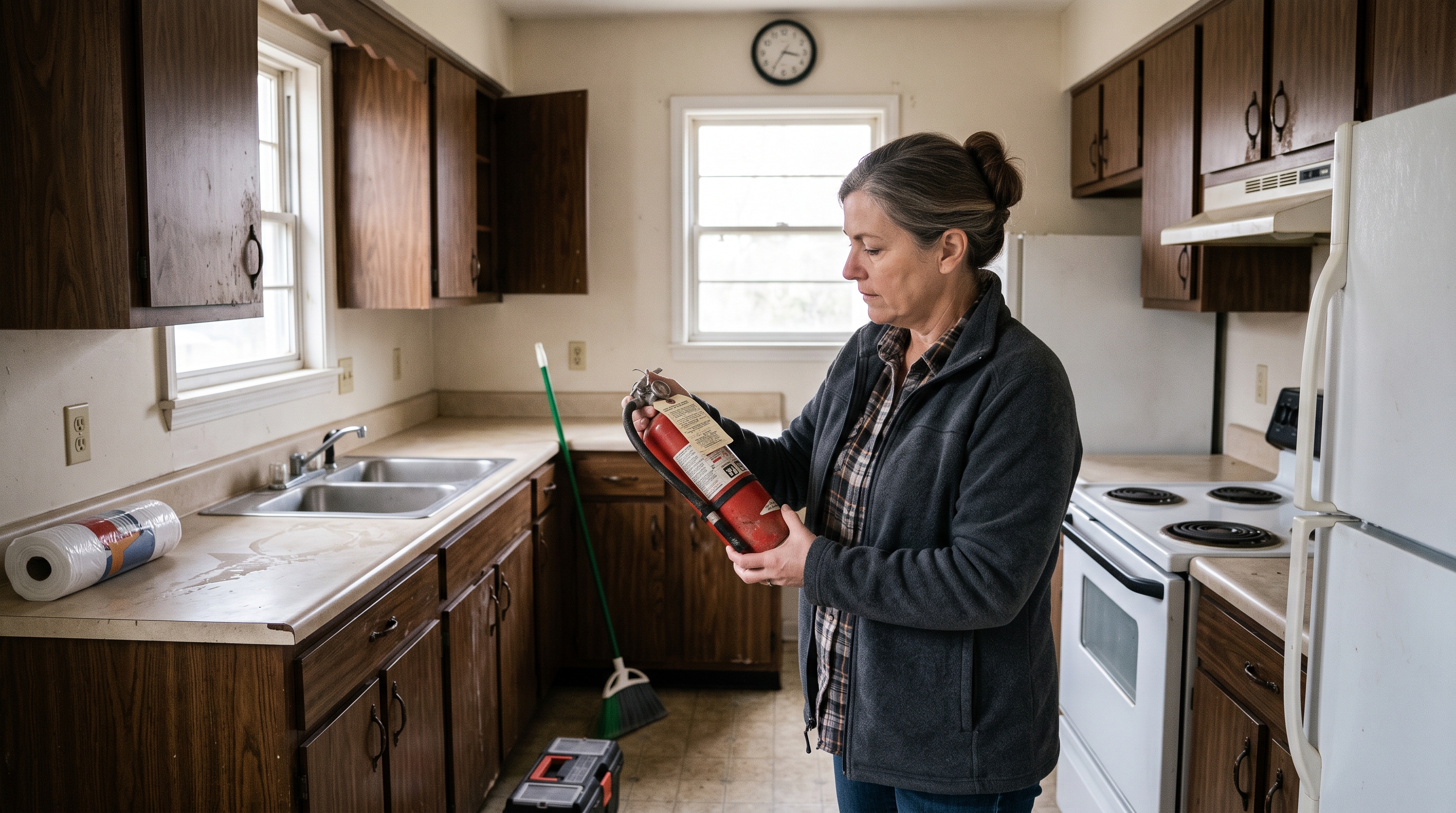
Short answer: No. Virginia does not require a portable fire extinguisher in every existing rental simply because the property is rented. The answer depends on the building type, the code that applied to the property, and any property-specific requirement. PMI James River handles that question as part of a structured rental maintenance and risk-control process rather than treating every extinguisher left behind at a property as automatically required.
The broader Virginia habitability and life-safety framework explains how safety conditions fit into landlord obligations generally. This guide stays focused on portable fire extinguishers: when Virginia requires one, why the 2011/2012 construction-code transition matters, what rating is required, and what maintenance follows once an extinguisher is supplied.
Key Takeaways
- Virginia does not impose one blanket portable-fire-extinguisher requirement on every existing rental dwelling.
- For covered one- and two-family homes and townhouses, Virginia added a kitchen-extinguisher requirement in the 2009 code cycle, effective March 1, 2011.
- The required unit is rated at least 2-A:10-B:C, or an approved equivalent, unless the qualifying sprinkler exception applies.
- Virginia allowed either the previous or 2009 code to be selected for permits during a one-year transition after March 1, 2011.
- PMI James River uses construction age as a practical screen. For newer or uncertain properties, supplying the compliant extinguisher is usually more sensible than researching old permit history.
- A supplied extinguisher is not maintenance-free. The NFPA 10 framework includes recurring visual inspection and annual professional maintenance.
In This Guide
- The requirement follows the building, not the lease
- Why the 2011/2012 cutoff matters
- What extinguisher does Virginia require?
- What about apartments, condos, and multifamily?
- What should an owner do with an old extinguisher?
- Inspection and maintenance after one is supplied
- PMI James River's practical rule
The Requirement Follows the Building, Not the Lease
A rental agreement does not create the fire-extinguisher requirement. The relevant building and fire codes do.
The current Virginia Statewide Fire Prevention Code makes the existing-building rule unusually explicit. Its portable-fire-extinguisher section notes that whether an extinguisher is needed in an existing building is determined by the USBC or other code in effect when the building was constructed.
That matters because an older rental does not automatically have to be upgraded every time a later code edition adds a new extinguisher requirement. It also means that finding an extinguisher hanging in a kitchen does not, by itself, prove that the extinguisher was legally required when the house was built.
This is one reason fire extinguishers belong in a deliberate property-management decision rather than a generic checklist. A property can have a required extinguisher, an optional owner-supplied extinguisher, or an old extinguisher that was simply left behind by a prior owner or resident. Those are not the same situation.
Why the 2011/2012 Cutoff Matters
The key residential change arrived with the 2009 Virginia Construction Code. That code became effective March 1, 2011 and added Section R329, Fire Extinguishers.
The new provision required a compliant extinguisher in the kitchen area of the covered dwelling unless the home had the qualifying approved sprinkler system.
Virginia also created a one-year transition. A permit applicant during the year after March 1, 2011 could choose whether to comply with the prior code or the new 2009 code. That means a property around the transition cannot always be classified perfectly from a Zillow-style "year built" field alone.
| Property Timing | Practical Starting Point | PMI James River Approach |
|---|---|---|
| Clearly before March 2011 | The property generally predates this residential kitchen-extinguisher requirement, although another property-specific rule can still apply. | Do not assume an old extinguisher must remain merely because one is present. |
| Around the 2011/2012 transition | The governing permit may have used either code during the transition period. | Take the conservative route and supply a compliant extinguisher rather than make routine management depend on permit archaeology. |
| Clearly newer property | Virginia residential codes in effect after the transition contain the kitchen-extinguisher requirement. | Supply the compliant unit unless the qualifying sprinkler exception or another known property-specific condition changes the answer. |
The permit record is still the stronger legal evidence if someone actually needs a definitive historical answer. PMI James River's operating judgment is simpler: when a newer property's applicability is uncertain, the cost and effort of supplying the proper extinguisher generally make more sense than turning every turnover into a code-history research project.
What Extinguisher Does Virginia Require?
The current Virginia Residential Code is specific. In covered dwellings without the qualifying approved sprinkler system, the kitchen area requires a fire extinguisher rated 2-A:10-B:C or an approved equivalent.
That rating matters. It is not enough to leave any red canister or fire-suppression product in the kitchen and assume the requirement has been met.
The U.S. Fire Administration's extinguisher guidance explains the rating system:
- Class A covers ordinary combustibles such as wood, paper, and cloth.
- Class B covers flammable and combustible liquids.
- Class C indicates the extinguisher is suitable around energized electrical equipment.
The numbers describe extinguishing capacity within the applicable class. For a Virginia residential kitchen requirement, the owner should look for the actual 2-A:10-B:C marking or an approved equivalent rather than relying on appearance, marketing language, or a small aerosol fire-suppression can.
The code says the extinguisher is installed in the kitchen area. Installation should follow the unit's listing, manufacturer instructions, and applicable code so the extinguisher is accessible rather than buried behind stored household items.
What About Apartments, Condos, and Multifamily?
This is where owners can get tripped up by the occupancy classifications in the fire code.
The current SFPC general portable-extinguisher list names Groups A, B, E, F, H, I, M, R-1, R-4, and S. Most of those letters describe commercial, institutional, assembly, industrial, or other nonstandard residential occupancies. R-1 generally covers transient residential uses such as hotels, while R-4 covers certain supervised residential occupancies.
Ordinary apartment buildings are different. Virginia's current occupancy rules classify residential occupancies with more than two dwelling units where occupants are not primarily transient as Group R-2. R-2 is not included in that general Section 906.1 occupancy list.
That does not mean an apartment or condominium building can never require extinguishers. The current fire code itself says existing-building requirements depend on the code under which the building was constructed. A specific hazard, common area, equipment room, building feature, prior approval, or another code provision can also change the answer.
The useful takeaway is narrower: "multifamily" is not a synonym for "portable extinguishers required everywhere." The specific building and the applicable code still control.
What Should an Owner Do With an Old Extinguisher?
An extinguisher left behind in a clearly older rental presents a management decision, not proof of a legal requirement.
PMI James River does not favor either extreme. We do not automatically remove every optional extinguisher, but we also do not recommend leaving an old one hanging in the kitchen indefinitely simply because it has always been there.
If the extinguisher is known to be required, it remains part of the property's safety baseline. If the property is clearly older and no requirement is apparent, the owner should make a deliberate choice:
- remove the optional extinguisher if the owner does not intend to maintain it as supplied safety equipment; or
- keep it, but treat it as an actual safety device that must remain serviceable and included in the property's recurring maintenance process.
An old, unmaintained extinguisher is not a free safety upgrade. A resident sees supplied fire equipment as something intended to work. Leaving an aging or discharged unit in place without a maintenance process can create precisely the kind of ambiguity a professional turnover is supposed to eliminate.
This fits the broader PMI James River Rent-Ready Standards: safety equipment should be intentionally present, functional, documented, and managed rather than inherited by accident.
Inspection and Maintenance After One Is Supplied
The important distinction is between a quick recurring inspection and professional maintenance.
Virginia DHCD's portable-fire-extinguisher life-cycle study, applying the NFPA 10 framework, describes visual inspections at 30-day intervals and maintenance at one-year intervals.
The 30-day visual inspection checks basic conditions such as whether the extinguisher is present, accessible, unobstructed, physically sound, and properly charged. DHCD notes that this visual inspection can be performed by anyone. What matters operationally is that the property has a reliable process for the check to occur and be documented.
Annual maintenance is different. It is a more detailed service of the extinguisher. Virginia's current SFPC specifically requires personnel providing or conducting portable-fire-extinguisher maintenance to possess a valid certificate from an approved agency or organization for the work performed.
That terminology is worth keeping straight. Owners often refer to the annual visit as "certifying the extinguisher." More precisely, the extinguisher receives annual maintenance and documentation, while the service person is the one Virginia requires to hold the applicable certification.
Certain rechargeable extinguishers also have longer internal-maintenance and hydrostatic-testing intervals depending on their type. Those longer intervals do not replace the recurring visual inspection or annual maintenance.
Owners should therefore consider more than the purchase price. Supplying an extinguisher also creates an inspection, service, documentation, and replacement workflow. This is why PMI James River does not add optional extinguishers casually to clearly older properties.
PMI James River's Practical Rule
For the ordinary Virginia single-family homes, two-family homes, and townhouses PMI James River encounters, the operating rule is intentionally conservative without turning every turnover into legal research.
- Start with the property's age and type. Construction age is a practical screen for whether the 2011/2012 residential-code transition is likely to matter.
- Clearly older property with no known requirement: do not assume an old extinguisher must remain. Decide whether it is intentionally being supplied.
- Property around the transition, clearly newer, or otherwise uncertain: supply a compliant 2-A:10-B:C extinguisher rather than routinely spending management time reconstructing old permit history.
- Known property-specific requirement: follow it. A prior inspection, building record, association requirement, fire official, or other reliable property-specific source can control the answer.
- Once an extinguisher is supplied or intentionally retained: put it into a recurring inspection and maintenance process rather than treating it as permanent wall decoration.
The same logic applies to other life-safety equipment. The goal is not to accumulate equipment. The goal is to know what should be there, confirm that it works, and maintain a defensible record. PMI James River's Virginia smoke and CO alarm checklist applies that same discipline to alarms.
For the broader owner duty line when a safety or maintenance issue is identified, use the guide to Virginia landlord maintenance responsibilities.
Frequently Asked Questions
Does Every Virginia Rental Need a Fire Extinguisher?
No. Virginia's current fire code expressly recognizes that extinguisher requirements in existing buildings can depend on the building code in effect when the property was constructed. The answer also depends on the building type and any property-specific requirement.
What Size Fire Extinguisher Does a Virginia Rental Need?
For the covered residential kitchen requirement, Virginia specifies a rating of at least 2-A:10-B:C or an approved equivalent. The code states the required rating rather than simply requiring any household fire-suppression product.
Does a House Built in 2011 Automatically Need One?
Not necessarily. The 2009 Virginia Construction Code became effective March 1, 2011, but permit applicants could choose the prior or new code during a one-year transition. The permit history can therefore matter around the cutoff. PMI James River's practical response to that uncertainty is normally to supply the compliant extinguisher rather than research the permit history for a low-cost safety item.
Do Apartment Buildings Automatically Need Portable Extinguishers?
No. Virginia's current general occupancy list for portable extinguishers does not include Group R-2, the classification generally used for nontransient residential occupancies with more than two dwelling units. A particular apartment or condominium building may still have extinguisher requirements based on its original code, specific hazards, common areas, or other property-specific provisions.
Does a Fire Extinguisher Need Annual Certification?
The more accurate description is annual maintenance by appropriately certified service personnel. The NFPA 10 framework also includes recurring visual inspection, generally at 30-day intervals. Virginia specifically requires personnel conducting portable-extinguisher maintenance to possess an applicable certificate.
A Small Safety Item Still Needs a System
A portable fire extinguisher is inexpensive compared with most rental-property safety equipment, but that does not make the compliance question meaningless. The useful approach is to separate three questions: Is an extinguisher required? If not, does the owner intentionally want to supply one? If one is supplied, how will it be inspected and maintained?
For PMI James River, the 2011/2012 code transition provides a practical screen. Clearly older homes generally do not need an optional extinguisher carried forward by default. Newer and uncertain homes are handled conservatively with a compliant unit. Any extinguisher that remains becomes part of the property's safety-maintenance system.
Rental owners who want PMI James River to manage these kinds of turnover and maintenance decisions as part of a consistent operating system can contact PMI James River.
Published: August 26, 2026