
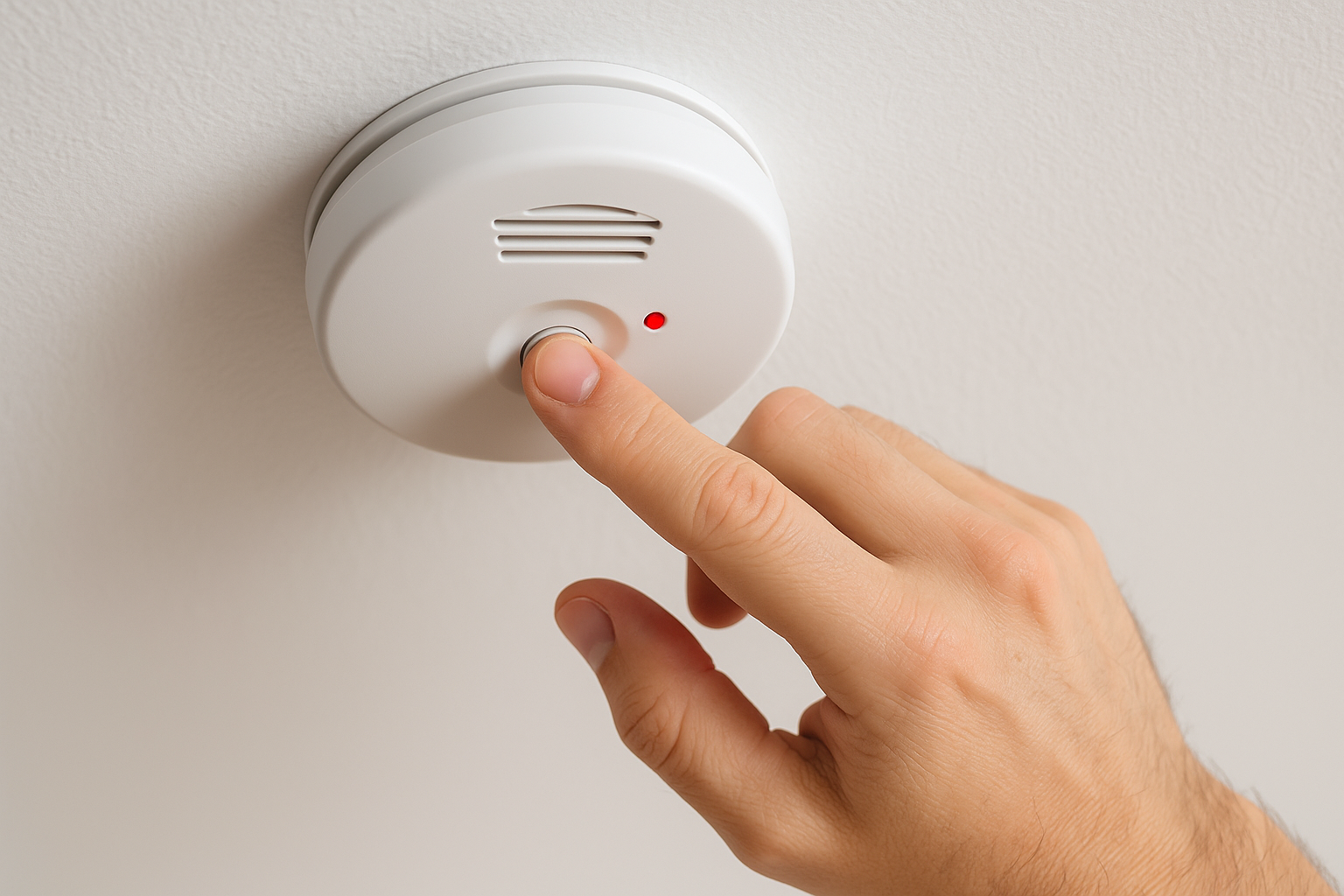
This checklist gives Virginia rental owners a practical way to inspect, place, test, replace, and document smoke and carbon monoxide alarms. It is designed to answer the operating question: what should an owner or property manager check, room by room, so the alarm record is useful at turnover, during the lease, and at the next annual certification?
PMI James River uses this process within its rental maintenance service and applies its bedroom smoke-alarm standard across older and newer rentals. The checklist keeps technical placement, testing, replacement, and documentation in one place without turning it into a separate legal-retrofit analysis.
Use this checklist for single-family homes, townhouses, and similar residential rentals. Multifamily fire-alarm systems, mixed-use buildings, and properties with central fire-alarm panels may require a different system review.
Key Takeaways
- A sound smoke-alarm baseline places alarms in every sleeping room, outside each separate sleeping area, and on every level of the home.
- Virginia's current residential code also includes layout-specific requirements, including a raised-ceiling rule that can require an additional alarm near a bedroom hallway.
- Virginia requires landlords to provide a smoke-alarm certificate stating that alarms are present, inspected, and in good working order no more than once every 12 months.
- A resident's written request triggers a 90-day deadline for the landlord to install a carbon monoxide alarm.
- Virginia law prohibits residents from removing or tampering with properly functioning landlord-installed smoke alarms or carbon monoxide alarms.
In This Guide
- Start with the property record
- Smoke alarm placement checklist
- Carbon monoxide alarm checklist
- Power, interconnection, and replacement
- Owner, resident, and certification duties
- PMI James River alarm review
Start With the Property Record
Start by documenting the system already in the home. Richmond City, Henrico, Chesterfield, and Hanover rentals include older houses with stand-alone battery alarms, newer homes with hardwired interconnected alarms, and properties that have been altered over time. The inspection should identify the actual system instead of assuming the layout from the year built.
Record:
- the construction year and occupancy type;
- permitted additions, renovations, and converted sleeping rooms;
- every bedroom and separate sleeping area, floor by floor;
- basements, habitable attics, and split-level conditions;
- fuel-fired appliances, fireplaces, and attached garages;
- each alarm's location, type, power source, interconnection, and visible manufacture or replace-by date;
- any central fire-alarm panel or monitored system; and
- prior inspection, certification, vendor, and replacement records.
If the property uses detectors connected to a central fire-alarm panel rather than self-contained household alarms, the system should be reviewed and tested under the requirements that apply to that system.
Smoke Alarm Placement Checklist
Virginia's residential code adopts the 2021 residential-code framework with Virginia amendments. The current Virginia Administrative Code residential provisions, a Chesterfield County summary of significant 2021 VRC changes, and the U.S. Fire Administration smoke-alarm guidance support the working placement checks below.
| Check | Working standard | What to document |
|---|---|---|
| Every sleeping room | Confirm a smoke alarm in each room used for sleeping. | Count actual sleeping rooms, including bedrooms created by additions or conversions. |
| Outside each sleeping area | Confirm an alarm outside each separate sleeping area in the immediate vicinity of the bedrooms. | Separate bedroom groups may need separate hallway or common-area coverage. |
| Every level | Use an alarm on every level of the home, including the basement, as the operating and public-safety baseline. | Do not overlook a basement, finished attic, or split-level layout. |
| Raised ceilings near bedroom halls | The 2021 VRC added a rule for a room open to a bedroom hallway when the room ceiling is at least 24 inches higher than the hallway ceiling. | Flag vaulted, stepped, or open layouts for a closer placement review rather than treating them like a flat hallway. |
| Cooking and steam nuisance areas | Follow the listed alarm type and manufacturer instructions for placement near cooking appliances, bathrooms, and other nuisance sources. | Repeated nuisance alarms are a reason to review placement or device type, not to disable the alarm. |
Current-code placement is a useful operating benchmark, but it does not by itself answer every retrofit question for an older rental. The separate Virginia smoke-alarm gray-area analysis addresses the legal interpretation issue without turning this checklist into a second version of that article.
Carbon Monoxide Alarm Checklist
Carbon monoxide requirements should be checked separately from smoke-alarm placement. Virginia's written-request statute, the residential code, and broader fire-safety guidance answer different questions.
| Question | Rule or safety baseline | Practical action |
|---|---|---|
| Where should CO alarms be placed as a safety baseline? | The U.S. Fire Administration recommends CO alarms outside each separate sleeping area and on every level of the home. | Map each separate sleeping area and identify potential CO sources before deciding whether existing coverage is adequate. |
| What if a resident makes a written request? | Virginia Code § 55.1-1229(E) requires the landlord to install a carbon monoxide alarm within 90 days. The landlord may charge a reasonable fee for equipment and labor. | Log the written request date, schedule the installation, and retain the completion record. |
| How should the device be selected and installed? | Virginia's current residential provisions recognize hardwired, plug-in, and battery CO alarms that meet the applicable listing and are installed according to the code and manufacturer instructions. | Record the alarm type, listing, power source, location, and service-life information rather than treating every CO alarm as interchangeable. |
| What if more than one CO alarm is required? | The current Virginia residential provisions require interconnection when more than one CO alarm is required, with listed wireless interconnection allowed. | Confirm whether all required alarms communicate as intended instead of checking only whether each unit sounds by itself. |
PMI James River uses a risk-based CO review where fuel-burning equipment, fireplaces, or attached garages create a foreseeable reason to check coverage. The 90-day written-request rule is an additional landlord duty, not the only reason to consider CO protection.
Power, Interconnection, and Replacement
Do Not Downgrade the Existing System Without Checking
A replacement alarm should fit the system already required for the property. A sealed battery model is not automatic permission to remove existing hardwiring or interconnection. When the home already has a hardwired or interconnected system, confirm the applicable requirement before changing the power or communication method.
Smoke-Alarm Replacement
Virginia's existing-building smoke-alarm replacement provision requires a repair or replacement smoke alarm to be listed and no more than 10 years from its manufacture date. When a replacement device is battery-only, the Virginia provision calls for a sealed battery with a minimum 10-year life.
The U.S. Fire Administration likewise recommends replacing smoke alarms when they are 10 years old. A successful button test does not reset an expired manufacture date.
Carbon Monoxide and Combination Alarms
- Carbon monoxide alarms: Follow the listed service life, end-of-life signal, and manufacturer instructions for the specific device.
- Combination smoke and CO alarms: Follow the replacement life stated for that listed combination unit.
- Unreadable dates: If the manufacture or replace-by information cannot be verified, treat the device as a replacement-planning issue rather than guessing its age.
Owner, Resident, and Certification Duties
Landlord Duties
Virginia Code § 55.1-1220 requires the landlord to provide a certificate stating that all smoke alarms are present, have been inspected, and are in good working order no more than once every 12 months. The landlord, an employee, or an independent contractor may perform the inspection.
Resident Duties
Virginia Code § 55.1-1227 separately prohibits a resident from removing or tampering with a properly functioning landlord-installed smoke alarm or carbon monoxide alarm, including removing working batteries so the alarm becomes inoperative. The statute also assigns the resident the applicable maintenance duty for those alarms during occupancy.
Documentation
A usable record should identify the property, inspection date, inspector, device location, alarm type, power source, interconnection, test result, visible manufacture or replace-by information, corrective work, and smoke-alarm certificate delivery. A generic note that the alarms "looked fine" does not tell the next inspector what was checked or when a device should be replaced.
PMI James River Alarm Review
During onboarding, turnover, or an annual review, PMI James River uses a repeatable room-by-room process:
- Draw or update the room-and-level alarm map.
- Confirm every bedroom and separate sleeping area.
- Identify each story, basement, habitable attic, and unusual split-level or raised-ceiling condition.
- Record fuel-fired appliances, fireplaces, and attached garages.
- Test every alarm using the device's test control.
- Photograph every alarm in place.
- Record manufacture, replace-by, or end-of-life information.
- Confirm the power source and required interconnection.
- Correct missing, expired, damaged, poorly located, or nonresponsive devices.
- Issue and retain the smoke-alarm certificate on the required cycle.
This process supports the broader Virginia habitability and life-safety review. More importantly, it leaves a record showing what was present, what worked, what was corrected, and what will need attention later.
Frequently Asked Questions
Does the Current Code Mean Every Older Virginia Rental Must Be Rewired?
No blanket conclusion should be drawn from the current code alone. The answer can depend on the property's code history, prior work, existing system, and the interaction between Virginia's building-code and landlord-tenant requirements. That is why the retrofit question is kept separate from this placement checklist.
Can a Sealed 10-Year Battery Alarm Replace a Hardwired Alarm?
Not automatically. A long-life battery does not by itself authorize removal of required building wiring or interconnection. The applicable requirement should be confirmed before an existing system is changed.
Does the 90-Day CO Rule Mean a Landlord Can Wait for a Resident Request?
No. Section 55.1-1229(E) creates a specific duty after a written request, but that does not replace other applicable building-code requirements or ordinary safety review. PMI James River does not treat the written request as the only reason to evaluate CO coverage.
How Often Should Alarms Be Tested?
The U.S. Fire Administration recommends testing smoke alarms monthly. PMI James River also tests and documents alarms during its annual certification process, at turnover, and when an alarm problem is reported.
Next Step
Owners who need a room-by-room alarm map or correction plan can request a PMI James River property review. The resulting record can identify existing devices, missing coverage, replacement dates, and corrections needed to bring the property to the management standard.
Published: August 28, 2025
Updated: August 23, 2026