
A garbage disposal that is silent is a different problem from one that hums, runs without grinding, or causes the sink to drain slowly. Identifying the symptom first can prevent repeated attempts that make a simple jam worse.
This guide covers safe resident checks for a disposal supplied with your Richmond rental. For the full maintenance library, start with our resident troubleshooting guide or the broader Resident Maintenance page.
Stop First If You See a Safety Problem
Stop using the disposal and do not continue troubleshooting if you see smoke or sparks, smell burning, notice unusual heat at the switch, outlet, or cord, or have water spreading near electrical equipment. Use the electrical warning signs guide for those conditions.
If water is actively escaping from a plumbing connection or supply component, stop using the sink and follow the water leak and shutoff guide.
Never put your hand or fingers into a garbage disposal.
In This Guide
- The disposal is completely silent
- The disposal hums but does not turn
- Poor grinding or slow drainage
- Leaks, unusual odors, or noise
- What to send with your maintenance request
The Disposal Is Completely Silent
- Make sure the wall switch is off before touching anything beneath the sink.
- If the disposal has an ordinary plug that is clearly visible in a dry cabinet, confirm that it is fully plugged in.
- Look at the bottom of the disposal for its small reset or overload button. If it is accessible, press it once.
- If the disposal plugs into a GFCI-protected outlet and the outlet has tripped, use the normal Reset button once, provided the area is dry and there are no electrical warning signs.
- Restore the wall switch briefly and note whether the disposal is now silent, humming, or running normally.
If it remains silent, stop there. The problem may be inside the appliance or its electrical supply.
The Disposal Hums but Does Not Turn
A humming disposal is usually receiving power but cannot rotate normally. Turn the wall switch off immediately and do not repeatedly try to run it.
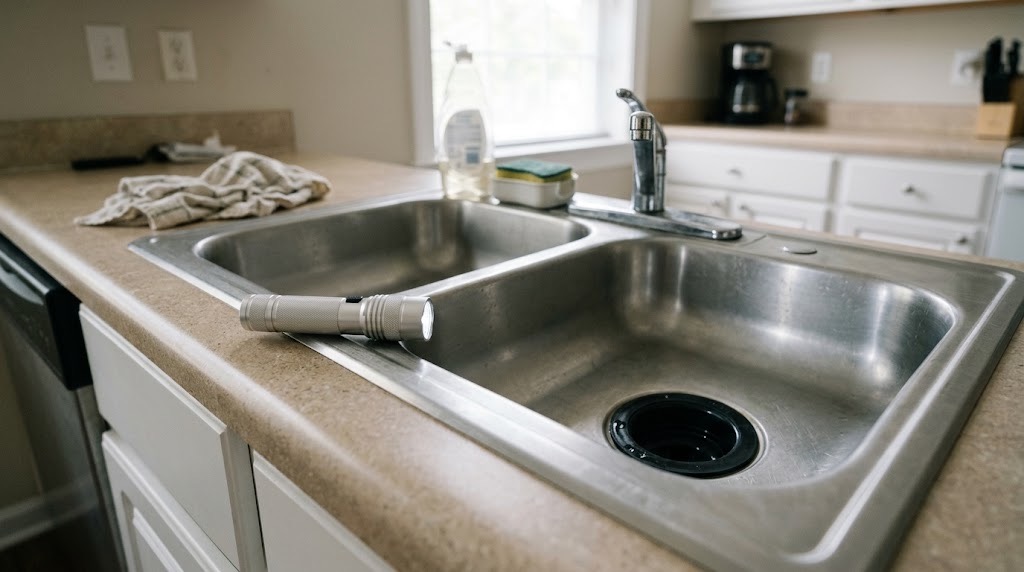
Use a flashlight to look into the opening from above. Do not reach inside and do not insert a screwdriver, broom handle, or other improvised tool into the grind chamber.
If the disposal has a manufacturer-designed wrench slot on the bottom, and it is a plug-in unit whose cord can be safely reached in a dry area:
- Turn the wall switch off.
- Unplug the disposal.
- Insert the correct disposal wrench or 1/4-inch Allen wrench into the bottom wrench slot.
- Work it back and forth from below to see whether the mechanism frees normally.
- Remove the wrench before restoring power.
If the disposal is hardwired, the plug cannot be safely reached, there is no bottom wrench slot, you are unsure which part you are looking at, or the mechanism will not free normally, stop and submit a maintenance request.
For a visual example of the manufacturer-designed wrench and reset method, see InSinkErator's garbage disposal troubleshooting video. Your disposal may be different, so PMI James River's safety limits above control.
Poor Grinding or Slow Drainage
If the disposal runs but the sink drains slowly, stop feeding additional food into it and tell us whether the sink drains normally when the disposal is off.
- If the problem appears only when the disposal is involved, it usually remains an appliance issue.
- If the sink is independently backed up even when the disposal is not being used, or other nearby drains are also backing up, tell us that specifically because the shared drain may be the real problem.
- If the disposal runs but does not grind normally, do not attempt internal disassembly.
Do not pour chemical drain cleaner into the disposal.
Leaks, Unusual Odors, or Noise
Stop using a leaking disposal until the source is identified. A leak from the sink flange, disposal body, or appliance itself may require appliance service. Water escaping from a plumbing or drain connection follows the water-leak troubleshooting path.
For an unusual grinding, rattling, or metallic sound, switch the disposal off and report what you heard. Do not reach inside to retrieve an unknown object.
If an ordinary odor remains after the sink and disposal have been used normally with adequate water, report it rather than adding caustic cleaners or trying to dismantle the unit.
What to Send With Your Maintenance Request
If the problem remains after the safe checks above, submit a request through the PMI James River resident portal. Include:
- whether the disposal is silent, humming, running without grinding, or making another sound;
- whether the reset button changed anything;
- whether the sink drains normally when the disposal is off;
- whether the dishwasher is also affected;
- any visible water leak; and
- a clear photo of the disposal beneath the sink if it can be taken without moving anything.
A disposal failure by itself is normally a maintenance issue rather than an emergency. If there is active flooding, fire, smoke, sparking, or another immediate hazard, use our rental emergency guide instead.
Published: September 2, 2026